How to use your egg log
Log once a day, at the end of the day, with everything you collected. A few habits make the chart honest:
- Log the zero days too. A day with no eggs is information. A day with no entry is a gap, and the chart treats it that way: missing days are skipped in the 7-day average instead of counted as zero.
- Add your flock size under My flock. The log then shows your lay rate: eggs per hen per day, as a percentage. Ten hens laying nine eggs a day is a 90% lay rate.
- Use the note field for anything unusual: a broody hen, a heat wave, new birds, a predator scare. When the chart dips, your notes usually explain why.
- Back up now and then. Your log is stored only in this browser. The Back up button saves a small file you can restore later, on this device or another one.
The lay-rate math is the same one Colorado State University Extension uses on its flock record sheet: the number of eggs divided by the number of hens. Oregon State University Extension describes a 90% rate as "9 eggs in 10 days for a single hen or 9 eggs from 10 birds daily."
How many eggs should my hens lay?
Fewer than one a day, even at their best. Mississippi State University Extension notes that "hens usually lay an egg about every 25 hours," so every hen skips days.
Over a year, the number depends heavily on breed and strain:
| Type of hen | Eggs per year | Source |
|---|---|---|
| Commercial White Leghorn | About 265 | Oregon State |
| Commercial sex-linked hybrids | 240–280 | Penn State |
| Rhode Island Red | 250–280 | Univ. of New Hampshire |
| Barred Rock, Australorp, Buff Orpington | 200–280 | Univ. of New Hampshire |
| Easter Egger | 180–200 | Univ. of New Hampshire |
| Standard Cochin | 100–160 | Univ. of New Hampshire |
| Heritage and purebred breeds in general | 50–100 or 100–180 | Penn State (two publications) |
Sources don't agree on heritage breeds: one Penn State publication says 50 to 100 eggs a year, another says 100 to 180, and New Hampshire lists 200 or more for popular dual-purpose breeds. The honest answer is that it varies a lot by breed and by the line your birds come from. Oregon State adds that backyard breeds generally lay fewer eggs than commercial Leghorns.
For a whole flock, University of New Hampshire Extension gives a handy benchmark: "Ten hens should lay about nine eggs per day once they all get started."
Reading your chart
The green bars are your daily counts. The red line is the 7-day average, which smooths out the normal day-to-day bounce so you can see the real trend.
- A slow slide over weeks usually means something seasonal: shorter days, the start of a molt, or hens getting older.
- A sudden drop over a few days points to something that changed: weather, water, feed, stress, a hidden nest or illness. Check your notes and the list below.
- A drop plus sick-looking birds is a different matter. See "Illness and parasites."
Why egg numbers drop
Oregon State puts it plainly: "a drop in egg production is the first sign of trouble." Usually the trouble is ordinary. Here are the common causes, roughly in the order you'll meet them.
Shorter days
Light drives laying. Penn State Extension notes that production falls "most often in September and October when the photoperiod reaches and dips below 12 hours per day." Oregon State says "a 14- to 16-hour day is typical" for laying hens.
Sources disagree on the ideal day length, from 12 to 14 hours (University of Georgia) to 16 to 18 hours (Mississippi State). Most land on 14 to 16, and Penn State advises against lighting adult birds for more than 16 hours a day.
If you add light in winter, Penn State's guidance is to:
- increase it slowly, "no more than 1 hour difference each week";
- add it "in the early morning and then let the natural sunset tell the birds when to come back to the coop";
- use warm light bulbs "(not heat lamps!)," keep to "bulbs up to 30-40 watts," and "be aware of fire risks."
Once you start, keep it steady. Oregon State warns that "even a 1-day lapse can have a negative impact." Extra light is optional, though: Penn State says "it does not harm the birds to allow them to molt naturally."
Molting
Most hens molt in the fall, dropping old feathers and growing new ones. During a molt, Oregon State explains, "the hen puts the bulk of her energy into feather growth, leaving little for egg production."
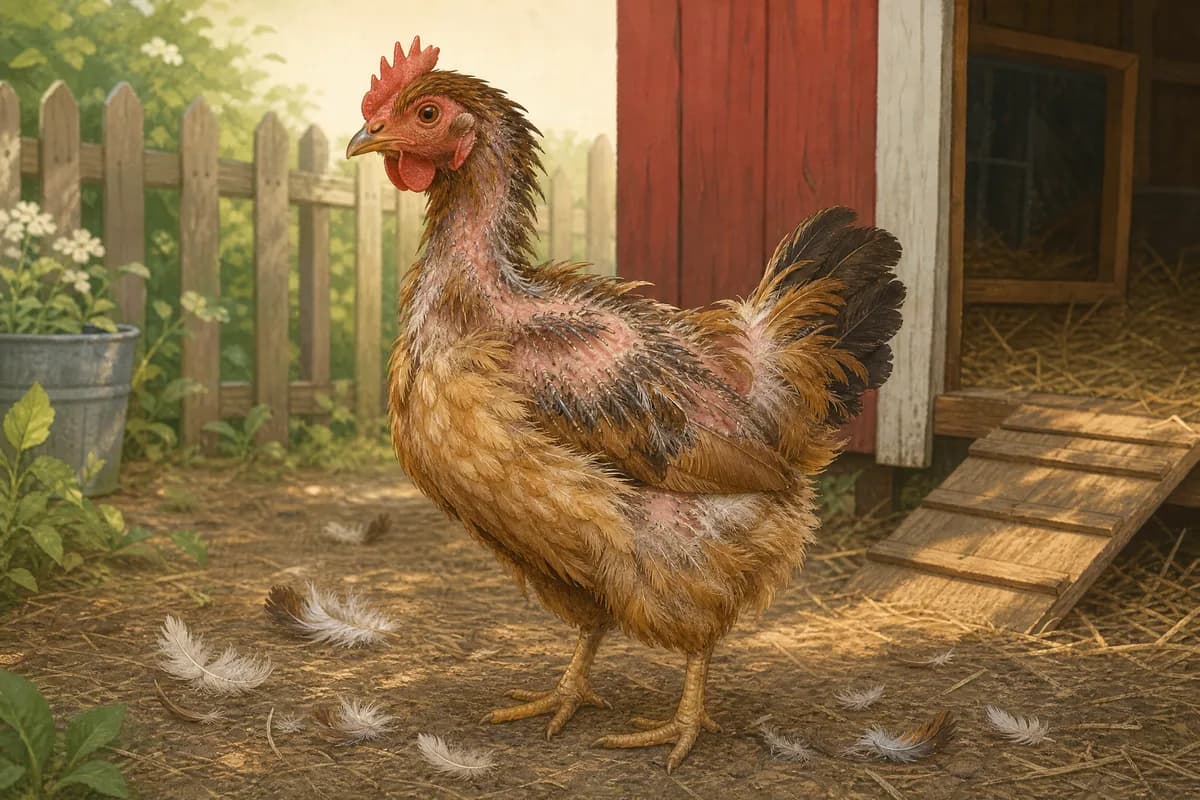
How long it lasts depends on what you measure. New Hampshire says new feathers come in "in about 6 weeks," while Penn State says birds take "about 10-12 weeks to complete a molt and come back into production." Expect a dip of a couple of months on your chart, and keep feeding a complete layer ration.
Age
Pullets usually start laying between 18 and 22 weeks of age, according to Mississippi State, and lighter breeds tend to start sooner than heavier ones. Oregon State says a hen reaches peak production at about 35 weeks, and that "chickens produce well until they are 2 to 3 years old, and then egg production declines."
That decline is gradual. New Hampshire notes that a 10-hen flock "will ease off to six to seven eggs per day after 13 months of production," and Penn State says hens lay fewer eggs with each additional laying cycle. No extension source we found gives a fixed percentage drop per year, so watch your own log year over year.
Heat, cold and bad weather
Texas A&M AgriLife Extension warns that "heat stress can reduce the quantity and quality of eggs," and that "one common result of heat stress among laying hens is thin eggshells." In hot weather, water matters even more: New Hampshire says birds "will consume 25% more water when temperatures soar over 80° F."
New Hampshire also lists "bad weather, dark days, severe cold, frozen water" among the things that slow laying. Our Coop Chore Checklist has the winter and summer to-dos.
Feed and water
Laying hens need a complete layer feed. New Hampshire recommends a ration of "about 16-18% crude protein and 4% calcium"; Oregon State says "about 16 percent protein and extra calcium (3 to 4 percent)." Oregon State also says not to "feed starter or grower diets to layers."
Treats count. Oregon State suggests keeping scratch to "about 10 to 15 percent of their total daily food consumption," and Penn State warns that "feeding table scraps or whole grains can decrease production, make the birds fat, and cause prolapse."
Water shortages show up fast. New Hampshire: "One day without water for any reason will result in less egg production the next few days as eggs are 75% water." If your chart dips right after a hot day or a frozen waterer, that's a likely reason.
Stress, broodiness and missing eggs
Oregon State lists "moving, handling, overheating, fright, and lack of food or water" as stresses that can slow laying. New birds, predators sniffing around the coop at night and rough handling all count.
A broody hen stops laying while she sits. Oregon State calls Cochins and Silkies "champions at going broody," while broodiness is "rare in Leghorns."
Sometimes the eggs are being laid, just not where you look:
- Hidden nests. New Hampshire notes that free-ranging hens "may lay eggs under buildings or out in the bushes." Oregon State's advice: "collect eggs daily from nests and hiding places."
- Egg eating. New Hampshire says it happens "especially if the birds are stressed by boredom, crowding, excessive heat and too-bright light."
Penn State recommends collecting eggs "two times daily," which helps "prevent egg breakage, broodiness, and the potential of egg eating."
Illness and parasites
USDA APHIS lists "decreased egg production" and "soft-shelled or misshapen eggs" among the warning signs of sick birds, alongside lack of energy, lack of appetite and sudden death. If a drop comes with any of those, call your veterinarian or USDA's hotline at 1-866-536-7593.
Parasites matter too: New Hampshire says mites "can result in lower egg production or death if not controlled" and suggests checking once a month.
Collecting and storing eggs
- Collect at least twice a day. Penn State, New Hampshire and Wisconsin all recommend it, and Wisconsin adds "preferably before noon."
- Refrigerate promptly. University of Arizona Extension says to "keep eggs at or below 45°F," and Penn State's rules for egg sellers use the same 45°F. Wisconsin recommends 35 to 40°F in the main part of the refrigerator.
- Wash carefully, or not at all. Arizona says to "avoid washing, as this removes the natural protective 'bloom.'" If you do wash dirty eggs, New Hampshire says to use warm running water (110 to 115°F) and to "NEVER soak or leave them in standing water."
Keeping your log safe
Your egg log is saved only in this browser on this device. Nothing is sent anywhere unless you sign up for the weekly nudge, and then only your totals and your hens' names go to our email service so your monthly report can include them.
To keep your log safe:
- Back up every few weeks and keep the file somewhere safe. Restore merges a backup into your log.
- Add the Egg Log to your home screen on your phone. It opens like an app, and on iPhone a home-screen app keeps its own storage. Do it before you start logging, or move your log over with Back up and Restore.
- Clearing your browser's history or site data deletes the log, so back up first.
Sources
- Oregon State University Extension, publication PNW 565
- Oregon State University Extension PNW 477: How to Feed Your Laying Hens
- Penn State Extension: Management Requirements for Laying Flocks
- Penn State Extension: Artificial Lighting for Winter Egg Production
- Penn State Extension: Successfully Raising a Small Flock of Laying Chickens
- University of New Hampshire Extension: Producing Your Own Eggs
- Mississippi State University Extension P3624
- Mississippi State University Extension: Why Do Hens Stop Laying Eggs?
- University of Georgia Poultry Science: Backyard Flock FAQ
- Texas A&M AgriLife: Backyard poultry producers should be wary of high temperatures
- USDA APHIS Defend the Flock: How to Spot Sickness
- Colorado State University Extension: poultry record sheet
- University of Wisconsin Extension: Egg Safety and the Backyard Flock
- University of Arizona Extension: egg handling
Last updated October 26, 2026. Figures checked against the university extension and USDA sources linked above. See our editorial policy.