Chicken Molting: How Long It Lasts and How to Help
Updated October 26, 2026 · Fact-checked against university extension sources (how we check)
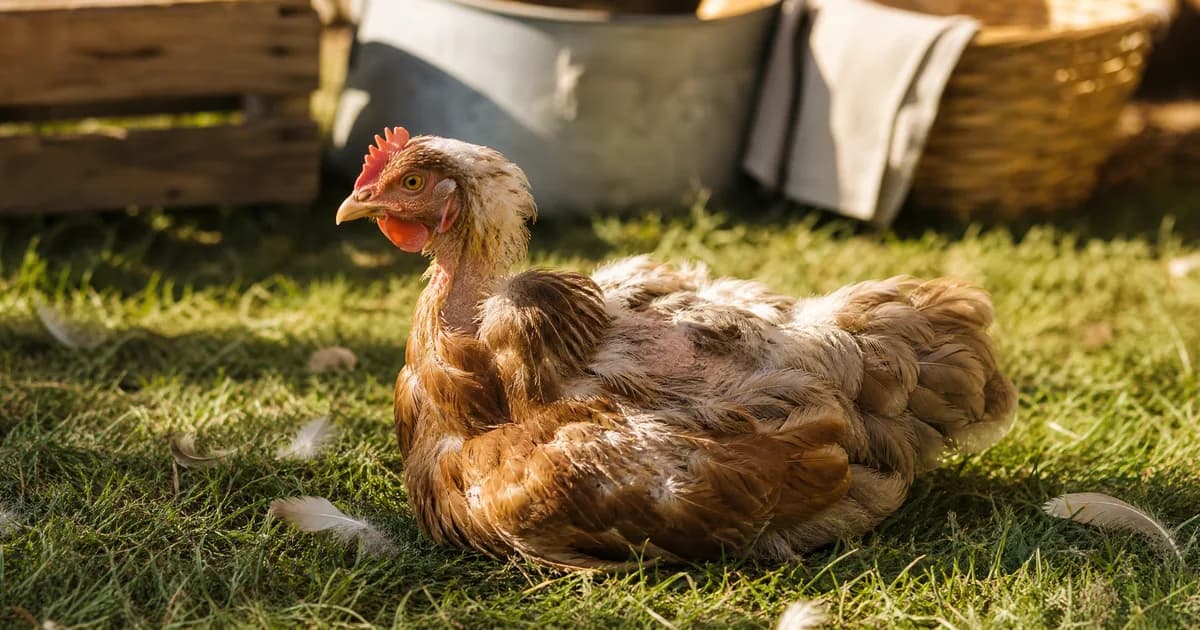
The coop looks like a pillow fight happened, your hens look a little rough, and the egg basket is nearly empty. Welcome to molting season. It's normal, it's temporary, and with a little help your girls will come out of it in shiny new feathers.
If you're tracking eggs in our free Egg Log, expect a dip that lasts a couple of months. Add a note like "molt started" so you can see it next year too.
What is molting?
Molting is how chickens replace their worn feathers with new ones. It usually happens once a year, most often in the fall as the days get shorter.
Growing feathers takes a lot out of a hen. Oregon State University Extension explains that during a molt "the hen puts the bulk of her energy into feather growth, leaving little for egg production." That's why laying slows or stops.
When do chickens molt?
- Season: usually fall. Oregon State says the molt "usually occurs in the fall," triggered by shorter days.
- First molt: Texas A&M's veterinary college says hens "typically exhibit their first full molt around 18 months of age," and UC Cooperative Extension Sonoma County agrees. Mississippi State Extension says good layers "will lay for 12 to 14 months before molting."
- Pullets hatched this spring are unlikely to go through a full molt this fall, since sources put the first full molt around 18 months.
What molting looks like
Feathers drop in a predictable order. Mississippi State: "The feathers are lost from the head first, followed in order by those on the neck, breast, body, wings, and tail." University of Kentucky describes the same pattern.
Not every molt is dramatic. Kentucky notes that some hens lose feathers gradually, and the molt may hardly show.
As new feathers grow in, you'll see pin feathers: short, waxy-looking tubes with the feather tip just opening.
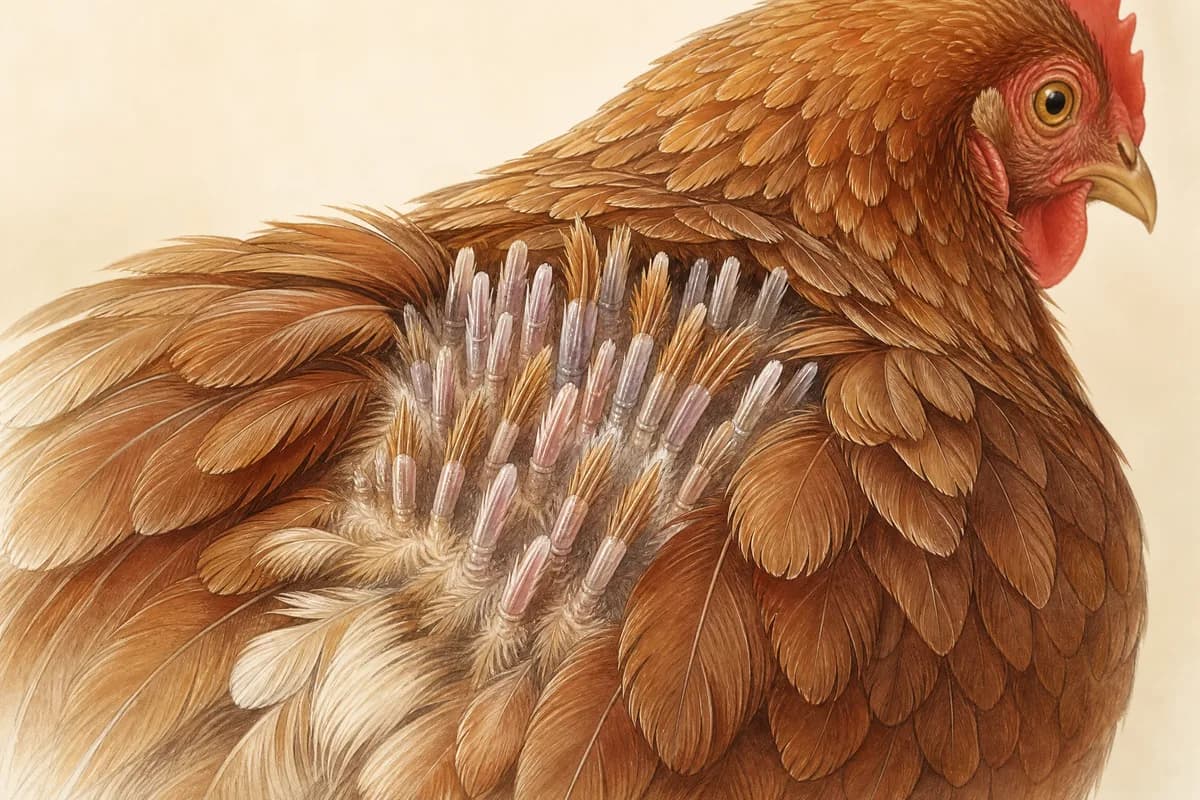
Bare spots aren't molting. Oregon State notes that "molt does not result in localized feather loss or bare spots." Oregon State says bare spots almost always come from feather picking, so a hen with a bald back or bare patches is more likely being pecked by flockmates. Watch the flock to find the culprit.
How long does molting last?
Sources give different numbers because birds differ and because some measure the feathers while others measure the eggs:
| Source | How long |
|---|---|
| Texas A&M veterinary college | "Most molting takes eight weeks from feather loss to replacement" (one to three months) |
| Univ. of New Hampshire | New feathers in "about 6 weeks" |
| Univ. of Kentucky | Commercial strains "four to six weeks"; heritage breeds "up to three to four months" |
| Penn State | "About 10-12 weeks to complete a molt and come back into production" |
| Mississippi State | Late molters 2 to 3 months; early molters "as long as 4 to 6 months" |
A good rule of thumb: plan on two to three months without many eggs.
Good layers molt late and fast
Mississippi State notes that late-molting hens "will produce longer before molting and will shed the feathers quicker (2 to 3 months)," while "early molters are usually poor producers in a flock." University of Florida IFAS adds that "poorer layers and older hens will molt more often and lay less consistently."
Do hens stop laying during the molt?
Most do. Mississippi State says "most hens stop producing eggs until after the molt is completed." Utah State University Extension adds that you may see some hens "laying eggs and losing feathers at the same time," especially with a gradual molt.
After each molt, expect a bit less. Utah State notes that "hens generally produce fewer eggs with each molt."
How to help your hens through the molt
Feed: the sources differ
Regrowing a full coat of feathers takes protein. In an article on feather loss, Penn State's Animal Diagnostic Laboratory notes feathers are "especially rich in the sulfur-containing amino acids such as methionine and cysteine," and that hens regrowing feathers "will need increased protein and a good balanced ration." How far to go depends on the source:
- Extra protein. Texas A&M's veterinary college says molting hens "should be fed a diet high in protein" and that "a 20% protein diet is usually adequate." UC Cooperative Extension Sonoma suggests you "can try putting the molters (only) back on chick starter diet to supplement their protein."
- A complete layer ration. Oregon State's laying-flock guidance is simply to "feed a layer ration free choice."
Either way, keep the main feed complete and cut back the extras. Penn State's lab advises: "Do not feed additional carbohydrate sources such as corn or sunflower seeds or bread treats as this dilutes the fully-fortified ration." If you switch molting hens to a higher-protein feed, keep oyster shell available for any hens still laying, and switch back when the new feathers are in.
Handle them gently
New feathers are delicate. Texas A&M's veterinary college: "The replacement pin feathers are very fragile and can be easily damaged," so "owners should limit handling and use caution when handling molting chickens."
Keep stress low
The same source says "it's also important to limit stressors during molt." Keep routines steady, avoid moving the coop, and hold off on changes you can postpone. If you do add new birds, Penn State's lab reminds keepers that "new birds upset the established pecking order," so introduce them carefully.
Keep them dry and out of drafts
A hen missing half her feathers has less insulation. Penn State's lab notes that "chickens without a good feather cover are susceptible to temperature stress." Make sure the coop is dry and draft-free but still ventilated, as on our Coop Chore Checklist.
Skip the forced molt
Commercial farms sometimes force a molt, but many countries now prohibit the fasting once used to do it, according to poultry extension specialists at extension.org. For a backyard flock, a natural molt is fine. Penn State says "it does not harm the birds to allow them to molt naturally."
When will my hens lay again?
When the new feathers are in. Mississippi State says most hens stop "until after the molt is completed," and Penn State puts the full return at about 10 to 12 weeks. If your hens finish molting in early winter, laying may stay slow until the days lengthen again, because short days hold laying back too. Our guide to why chickens stop laying covers adding light safely if you want winter eggs.
Keep logging through the molt. In the Egg Log, you'll see the 7-day average start to climb as each hen comes back into lay, and next fall you'll know exactly what to expect.
Raising pullets for next year? See when do chickens start laying.
Sources
- Mississippi State University Extension: Molting Laying Hens
- University of Kentucky ASC-236
- Oregon State University Extension PNW 565: Why Did My Chickens Stop Laying?
- Texas A&M College of Veterinary Medicine: Hen molting
- UC Cooperative Extension Sonoma County: Poultry 101
- Penn State Animal Diagnostic Laboratory: Pecking order of chickens
- Penn State Extension: Management Requirements for Laying Flocks
- Penn State Extension: Artificial Lighting for Winter Egg Production
- University of New Hampshire Extension: Producing Your Own Eggs
- Utah State University Extension: Basics for Raising Backyard Chickens
- UF/IFAS PS029: Factors Affecting Egg Production in Backyard Chicken Flocks
- Poultry Extension: Feeding Chickens for Egg Production