Eggs Not Hatching on Day 21? What to Check
Updated October 24, 2026 · Fact-checked against university extension sources (how we check)
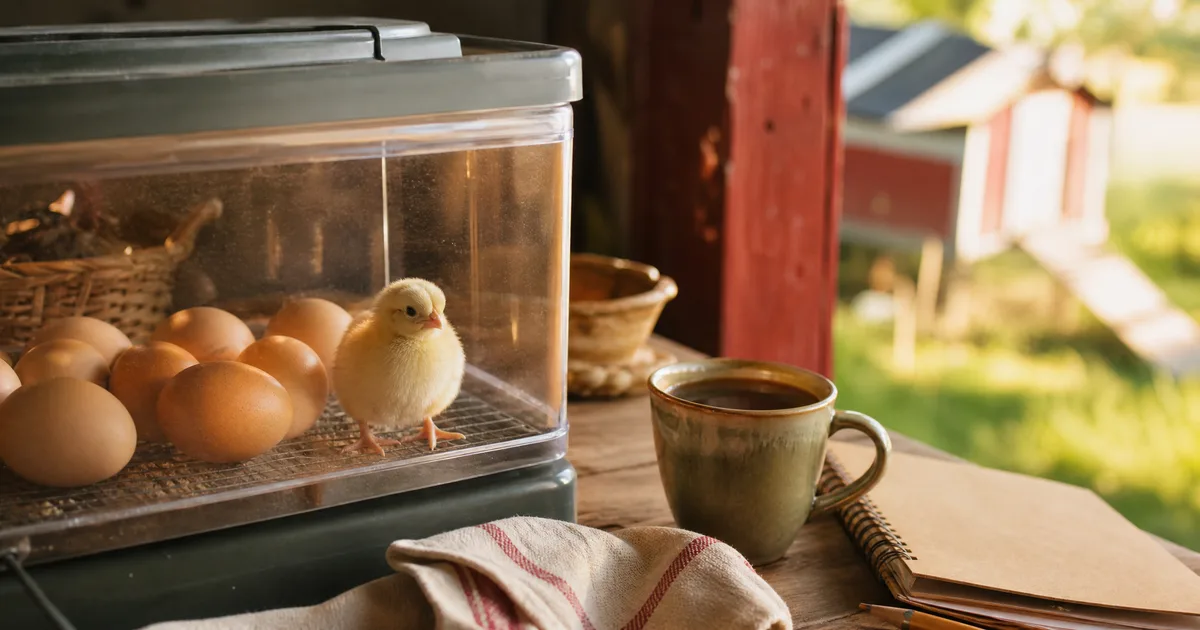
Day 21 is circled on the calendar, the coffee is made, and the incubator is… quiet. Before you start mourning, take a breath. A late hatch is common, and a few simple checks will tell you whether to wait or call it.
If you haven't already, put your set date into our egg hatching calculator. It shows your hatch window and the date to call it for chickens, ducks, quail, turkeys, geese and guinea fowl.
1. Check your count
Count the day you set the eggs as day 0. Chicken eggs set on a Saturday are due on a Saturday three weeks later. If you counted the set day as day 1, your "day 21" is really day 20, and your chicks aren't late at all.
Also check that you're using the right number for your bird. Ducks, turkeys and guinea fowl take about 28 days, Coturnix quail about 17, and Muscovy ducks 35 to 37, according to Mississippi State University Extension.
2. Remember the hatch window
A hatch date is a target, not a deadline. Utah State University Extension says some chicks "will hatch a day or two early if temperatures are a little high and may hatch a day or two late if temperatures are a little low. Even a half of a degree makes a huge difference."
Texas A&M AgriLife Extension says chicks "should start to pip within a day of the incubation period listed for the species." Virginia Tech's embryology tip sheet says you "may begin to hear the chicks peep on day 20."
3. Check your thermometer
A slow hatch is usually a temperature story. Mississippi State: an incubator that "runs consistently cooler tends to produce late hatches." University of Minnesota Extension lists "temperature too low" as the cause of eggs "not pipping until 21st day or later."
Put a second thermometer in the incubator next to the first. If they disagree by a degree or more, you've likely found your answer. For a forced-air incubator, sources recommend 99.5 to 100°F (Texas A&M and Mississippi State); still-air incubators run warmer, measured at the top of the eggs.
4. Candle before you give up
If you're past the due date, a quick candling can save you from throwing out live chicks. A developing egg looks mostly dark with an air cell at the wide end: Texas A&M says that late in incubation "only a dark mass and the air cell are seen." An egg that lets light straight through never developed. See our candling guide for what to look for.
Be quick, and don't open the incubator more than you have to: low humidity is hard on chicks that are getting ready to hatch.
5. Decide how long to wait
Here's what extension sources say:
- Texas A&M: "Eggs that remain unhatched for 1 day beyond the predicted incubation period should be discarded."
- Utah State: "If a chick has not hatched by one or two days after the hatching period, they likely will not survive."
- University of Illinois Extension: "Remove and discard all unhatched eggs 60 hr after first chick hatches."
Our calculator's "call it" date is two days past the due date, or the end of the normal hatch window for birds with a longer range, like geese.
Pipped but not hatching
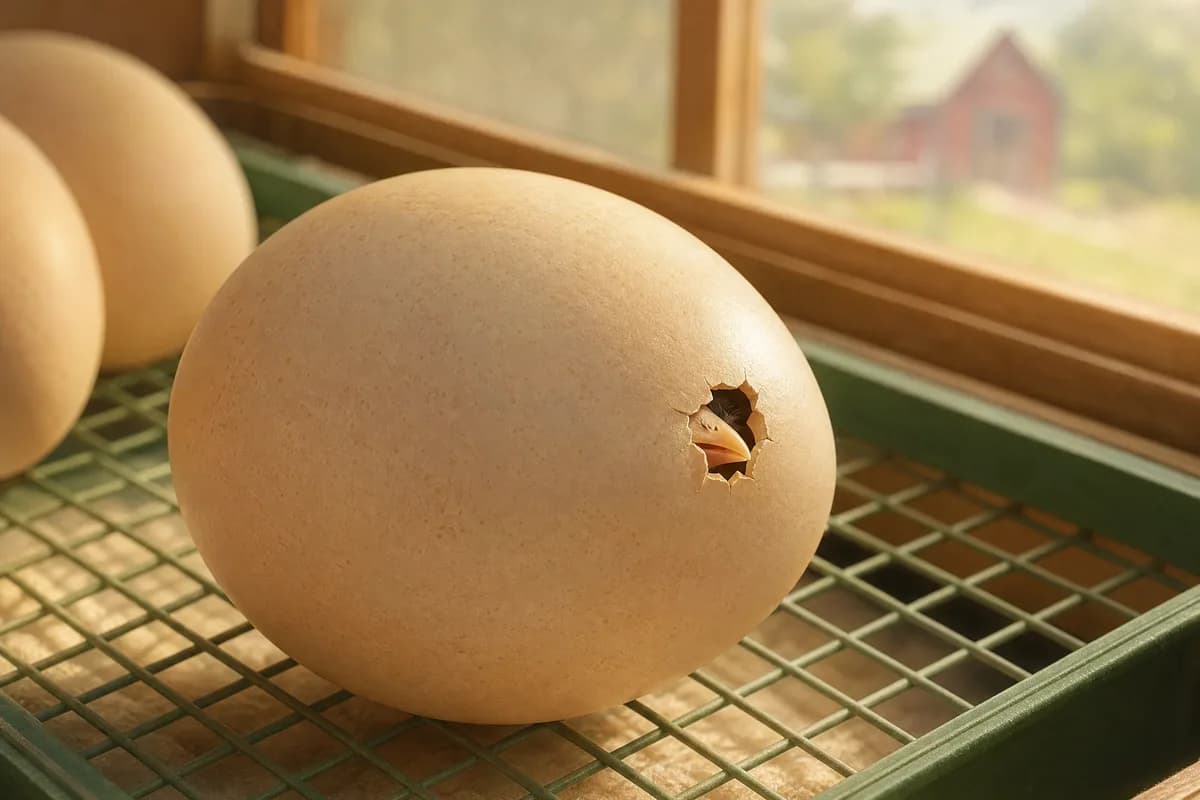
A pip is the first small hole a chick breaks in the shell, and it's only the start. Texas A&M says "the entire hatching process requires 10 hours to 20 hours" and not to be concerned "unless the process exceeds 20 hours." Its tip sheet notes chicks "may take nearly 24 hours to hatch."
Should you help?
Every source we checked says no:
- Texas A&M: "Do not help chicks out of their shells. If they cannot hatch themselves, they likely will not survive."
- Utah State: "Attempts to free a chick from its shell are usually unsuccessful."
- Virginia Tech: "Do not 'help' chicks hatch out of their eggs."
It's one of the hardest parts of hatching. Keep the lid closed and the humidity up, and let the chick work.
"Shrink-wrapped" chicks
Keepers use "shrink-wrapped" for a chick stuck inside dried-out membranes. Extension publications describe the cause rather than the name: Texas A&M says "the shell membranes should not dry to the chick during hatch," and when humidity is too low, "the membranes will be too tough to break." The fix is prevention: raise humidity at lockdown and keep the lid shut.
What went wrong? Common causes
Troubleshooting tables from University of Minnesota and Texas A&M point to the same usual suspects:
| What you saw | Likely causes |
|---|---|
| Late hatch, or no pips until day 21 or later | Temperature too low (Minnesota); also large or old eggs (Texas A&M) |
| Early hatch | Temperature too high (Mississippi State, Minnesota) |
| Pipped but didn't hatch, chicks dead in shell, sticky chicks | Low humidity, low temperature, or low humidity at hatching time (Minnesota) |
| Air cell too large | Humidity too low (Texas A&M) |
| Air cell too small | Humidity too high (Texas A&M) |
Setting up for a better next hatch
- Calibrate your thermometer before you set eggs, and keep it at egg height.
- Store eggs well. Mississippi State recommends about 55°F and 75% humidity, "with the small end pointed downward," and setting eggs within 7 days. Texas A&M says hatchability "decreases rapidly" after 10 days of storage.
- Warm eggs before setting. Texas A&M suggests letting them reach room temperature for 4 to 8 hours.
- Turn at least three times a day, an odd number of times, until lockdown (University of Minnesota and University of Illinois).
- Watch the air cell when you candle, and adjust humidity as you go.
- Set reminders. Our calculator can add every milestone to your calendar so lockdown day doesn't sneak up on you.
Sources
- Mississippi State University Extension: Important Incubation Factors
- Texas A&M AgriLife Extension B-6092: Incubating and Hatching Eggs
- Texas A&M AgriLife Extension EPS-003: Tips for a Successful Hatch
- Utah State University Extension: Hatching and Caring for Chicks
- University of Minnesota Extension: Hatching and Brooding Small Numbers of Chicks
- University of Illinois Extension: Incubation and Embryology
- Virginia Cooperative Extension: Embryology Tip Sheet