How to Candle Eggs: What to Look for Day by Day
Updated October 24, 2026 · Fact-checked against university extension sources (how we check)
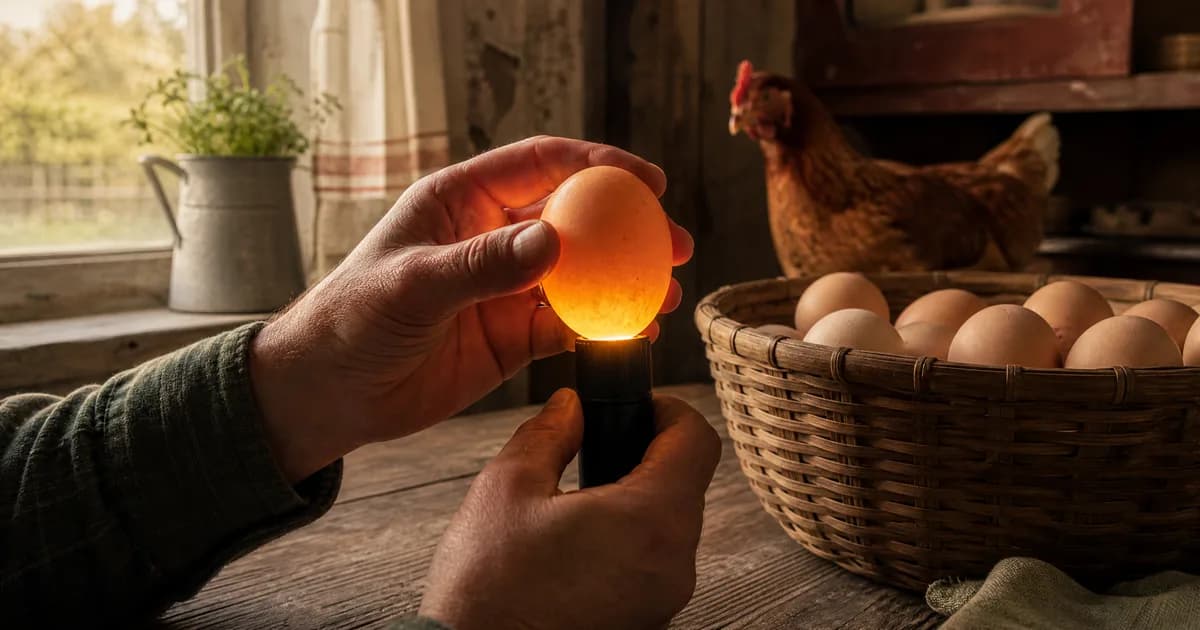
Candling is the closest thing you get to an ultrasound for eggs. You shine a bright light through the shell in a dark room and look at the shadows inside. It tells you which eggs are growing, which never started and which stopped along the way, so you can take the duds out before they spoil.
Not sure which day you're on? Plug your set date into our egg hatching calculator and it will mark your candling days on a calendar.
Why candling matters
An egg that isn't developing doesn't just sit there quietly. University of Minnesota Extension warns that eggs that stop developing "will rot quickly and may explode in the incubator," and that's a mess (and a smell) you don't want near healthy eggs. Candling also tells you whether your humidity is on track, through the size of the air cell.
What you need
- A bright, narrow light. A purpose-made egg candler works, and so does a small, bright LED flashlight. You want a beam about the size of the egg so light goes through the shell instead of around it.
- A dark room. The darker the room, the more you'll see.
- Clean, dry hands and a soft towel to set eggs on.
Dark brown and speckled shells let less light through, so give your eyes a minute to adjust and don't panic if you can't see much in a dark egg.
How to candle without hurting the eggs
- Work fast. Every minute out of the incubator is a minute of cooling. Utah State University Extension advises "opening the incubator as little as possible" to hold the temperature steady.
- Hold the egg big end up against the light, tilting it gently to see the whole inside.
- Return each egg as soon as you've looked. If you're candling a big batch, do a few at a time.
- Mark what you see on the shell in pencil or in a notebook, so you can compare on your next check.
Day 7: the first check
By about a week in, a fertile, developing chicken egg shows a living network inside. Utah State: "A healthy embryo will show veins extending and attaching to the eggshell by Day 7." Texas A&M AgriLife Extension describes the embryo itself as "a dark spot that becomes larger as incubation progresses."
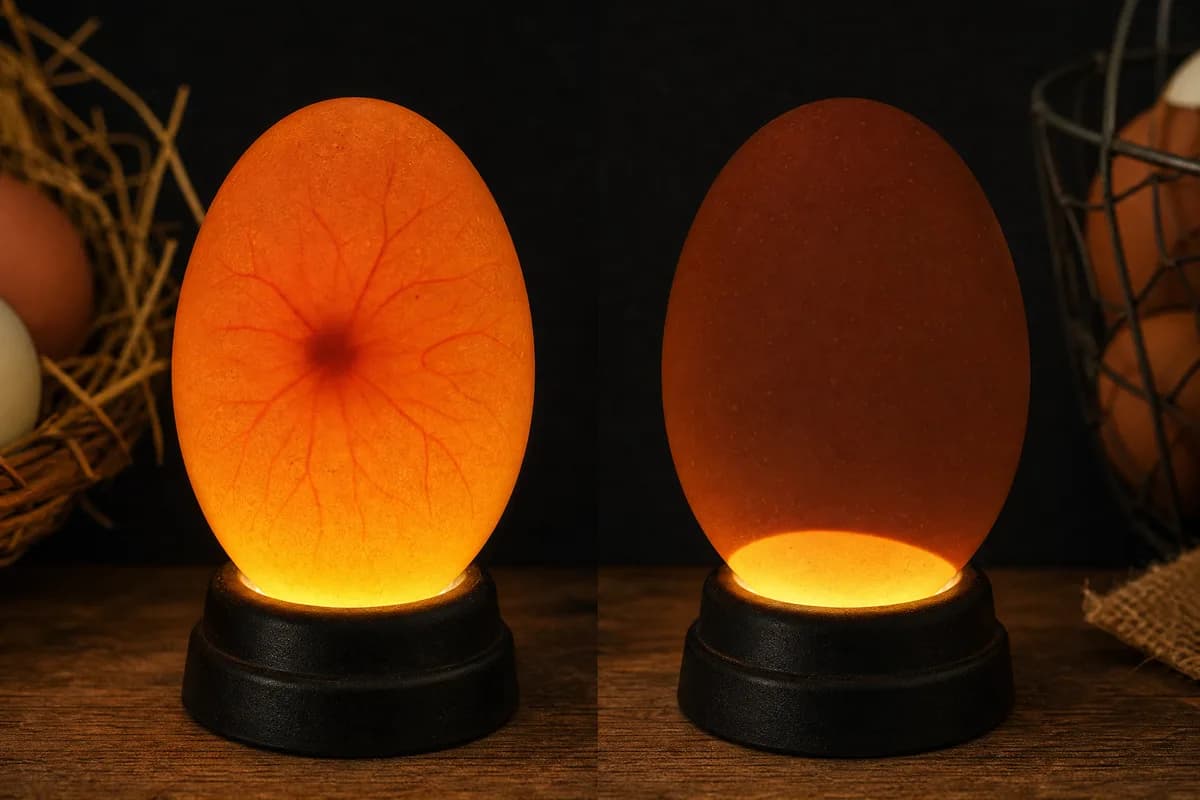
Here's how to read what you see:
| What you see | What it likely means | What to do |
|---|---|---|
| Red, spider-like veins spreading from a dark spot | Developing embryo | Keep it in |
| Light passes straight through, no dark areas | Clear egg: infertile or never started | Remove it |
| A red ring or smear, no healthy veins | Embryo that died early | Remove it |
Texas A&M puts the clear egg plainly: "An infertile or unincubated egg brightly transmits light in comparison." For eggs that stopped early, Texas A&M says dead embryos "will sometimes appear as a ring or smear of blood in the egg or a dark spot dried to the inside of the shell," and Utah State describes a "ring around the egg sack with no healthy veins."
Not sure? Leave a questionable egg in and check it again in a few days. Minnesota's advice is to remove eggs that "appear clear at 4 to 5 days" or "show little development at 10 days," which gives you a second chance to compare.
Day 14: the second check
By the middle of incubation the chick has grown a lot. Utah State says "at Day 14, a chick can usually be seen," and Texas A&M says that eventually "only a dark mass and the air cell are seen." A healthy egg looks mostly dark, with a clear pocket of air at the wide end.
Remove any egg that looks the same as it did on day 7, or that shows a ring or dark smear where veins used to be.
Reading the air cell
The air cell is your built-in humidity gauge. As the egg loses water during incubation, the air cell grows. Mississippi State University Extension says an egg's weight "must decrease by 12% during incubation if good hatches are expected."
Compare the air cell between checks:
- Air cell too small for the stage: humidity has been running high. Texas A&M lists "humidity too high" as the cause.
- Air cell too large: humidity has been running low.
Utah State sums up the fix: "To increase the air sack, decrease the humidity; to decrease the air sack, increase the humidity." Our egg hatching calculator shows the target humidity for each phase of incubation.
When to stop candling
Sources disagree a little here. Virginia Tech's embryology tip sheet suggests candling on days 7, 14 and 18, while Utah State says "after 14 days, most eggs should not be candled to keep the developing chick at a constant temperature."
A sensible middle ground: do your main checks on days 7 and 14. If you want a last look before lockdown, be quick about it, and once lockdown starts, keep the lid shut.
Candling ducks, quail, turkeys and geese
Extension sources don't publish separate candling days for every bird. Texas A&M suggests candling at about one-third of the way through incubation, and that's the date our calculator gives for ducks, quail, turkeys, geese and guinea fowl. Bigger eggs like duck and goose eggs need a stronger light to see through.
What candling can't tell you
Candling shows you development, not the future. An egg that looks perfect on day 14 can still struggle at hatch time if the humidity drops during lockdown. If you're past the due date and still waiting, read our guide to eggs not hatching on day 21.
Sources
- Utah State University Extension: Hatching and Caring for Chicks
- Texas A&M AgriLife Extension B-6092: Incubating and Hatching Eggs
- University of Minnesota Extension: Hatching and Brooding Small Numbers of Chicks
- Mississippi State University Extension: Important Incubation Factors
- Virginia Cooperative Extension: Embryology Tip Sheet