How much space do chickens need?
Space is one of the most important things you'll give your flock, and one of the hardest to add later. NC State Extension puts it simply: "low-density housing (more space per bird) results in less stress for the birds," and "less stress means less pecking and fewer health issues." The calculator above turns extension guidance into square feet for your flock; this guide explains where the numbers come from and how to use them.
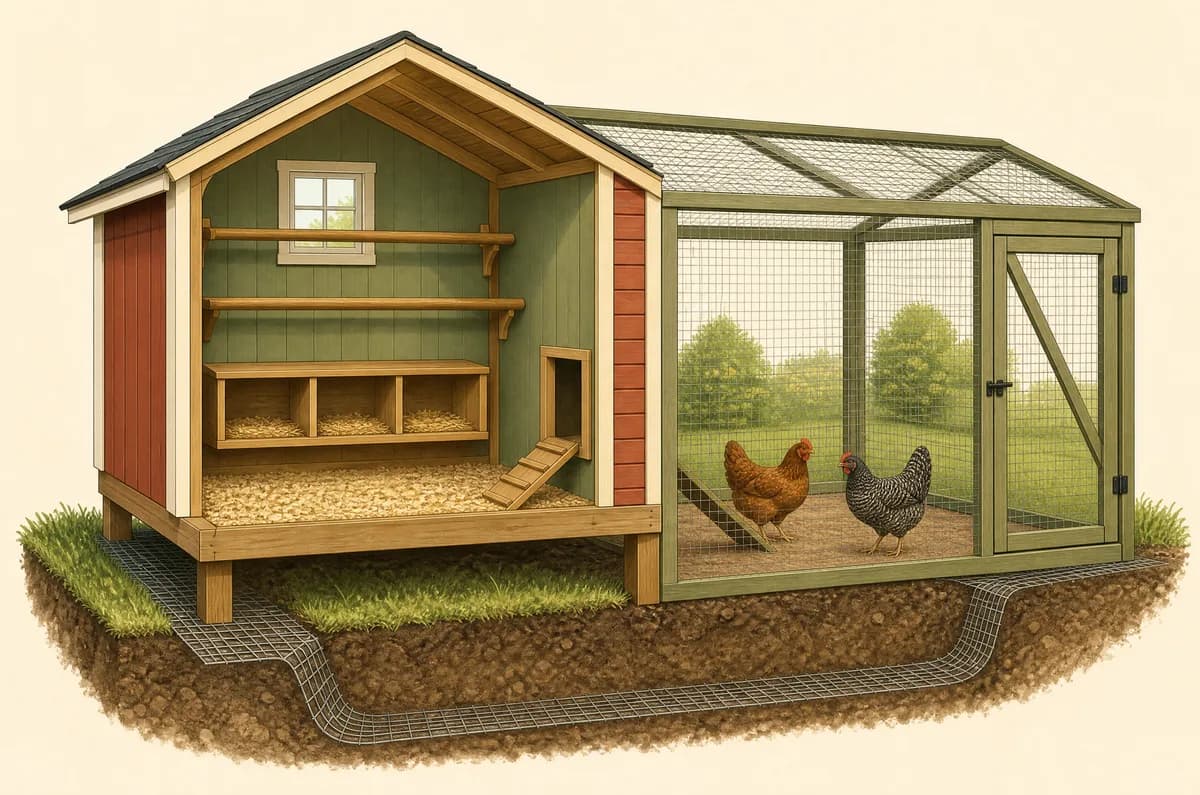
Coop floor space per chicken
Extension sources agree on the idea but not on one number, so the calculator shows a range: the lowest figure any source gives, and the roomier figure we lead with.
| Bird size | Minimum | Recommended | Sources |
|---|---|---|---|
| Bantams | 1 sq ft | 2 sq ft | Maryland; Colorado State |
| Lightweight (Leghorn, Polish) | 1.5 sq ft | 3 sq ft | Maryland; NC State; Colorado State |
| Standard (Rhode Island Red, Orpington) | 2 sq ft | 3.5 sq ft | Maryland; NC State |
| Large and heavy (Brahma, Cochin, Jersey Giant) | 3 sq ft | 4 sq ft | Colorado State |
These are for birds that also have a run or yard. A few notes from the sources:
- University of Maryland Extension lists 1 sq ft per bird inside for bantams, 1.5 for laying hens and 2 for large chickens.
- NC State Extension recommends "a minimum of 2.5 to 3.5 square feet per bird inside the weather-tight coop." It mentions lower figures (1.5 to 2 sq ft for light breeds, 2 to 3 for larger brown-egg breeds) but explains these come from large commercial operations and represent the minimum for survival and egg production.
- Colorado State Extension (Boulder County) gives 2.5 to 3 sq ft for light breeds and 3 to 3.5 for heavy breeds, and 2 to 4 sq ft overall "depending on breed size."
- Oregon State Extension recommends "at least 3 square feet per bird if there is access to a run or outdoor area."
Heavy breeds need the most room. If you're not sure how big your breed gets, look it up in our Breed Directory: each profile lists standard weights, and the calculator lets you pick breeds directly.
If your chickens never leave the coop
Birds that live indoors full time need far more coop space. Oregon State Extension recommends "8 to 10 square feet per bird if there is no outdoor access." That's why the calculator's answer jumps when you choose "No, they stay in the coop."
Free-ranging birds still need a coop that holds everyone comfortably at night and in bad weather, so the calculator treats free range the same as a run.
Run space per chicken
| Bird size | Minimum | Recommended | Sources |
|---|---|---|---|
| Bantams | 4 sq ft | 6 sq ft | Maryland; Colorado State |
| Lightweight | 4 sq ft | 8 sq ft | NC State; Maryland |
| Standard | 5 sq ft | 10 sq ft | NC State; Maryland |
| Large and heavy | 6 sq ft | 10 sq ft | Colorado State; Maryland |
NC State calls for "an additional minimum of 4 to 5 square feet per bird in the fenced, outside area." Maryland lists 4 sq ft for bantams, 8 for laying hens and 10 for large chickens, and Colorado State gives 6 to 10 sq ft "based on breed size."
For the run surface, NC State says "dry sand is a perfect ground cover for the outside run area of the coop."
Roosts: how much perch per chicken
Chickens sleep on roosts, so plan enough perch for everyone at once.
- Length per bird: Oregon State allows "5 to 10 inches of pole per bird," Colorado State 6 to 12 inches "based on breed size," and NC State "a minimum of 9 or 10 inches of perch." The calculator uses the low end for bantams and the high end for heavy breeds.
- Height and spacing: Oregon State says to "set the poles 2 feet off the floor with 10 inches between each pole." NC State allows "about 14 inches of horizontal distance between perches."
- Shape: Oregon State recommends "1- to 2-inch square lumber with the top edges rounded off," warning that "poles that are too small or too round may cause foot problems." NC State suggests 2-by-2 lumber "with the upper edge slightly rounded."
- Silkies: Oregon State notes "roosting poles for silkies should be only 1 foot off the ground." The calculator reminds you when you add Silkies.
Nest boxes: how many and how big
- How many: about one for every four hens. Oregon State says "build one nest box for about every four birds," Penn State "at least one 12-inch-by-12-inch nest for every four hens," Colorado State one for every three to four, and NC State "at least one nest box for every four or five hens."
- Size: Oregon State suggests about 12 inches deep by 12 wide by 12 tall; NC State says "a nest 12 inches by 14 inches should be large enough for any breed."
- Placement: off the floor, but not higher than the roosts. Oregon State says to "avoid placing nesting boxes directly on the ground or lower than roosting poles," and NC State puts nests "at the rear of the hen house away from windows."
- Bedding: NC State recommends "a 6-inch deep layer of shavings or straw."
Utah State Extension lists putting nest boxes in at 16 to 20 weeks, before pullets start to lay. Our Laying Calculator reminds you when.
Ventilation, light and bedding
- Air without drafts. Oregon State says to "build in as much ventilation as possible without creating drafts or access for predators," and notes "coops do not need to be insulated, but be sure there are no drafts." If you use fans, "be sure the fans do not blow air directly on the birds."
- Windows. NC State suggests positioning the coop "so that the window faces the morning sun," to provide lots of light without as much summer heat.
- Litter. NC State recommends "about 4 inches of moisture-absorbent litter, such as wood shavings," stirred often "to keep it dry and to prevent caking."
Keep predators out
A big coop isn't worth much if a raccoon can get in. Extension guidance:
- Close the flock in at night. Oregon State: "Design a coop that closes the flock inside at night."
- Solid floor. Use "secure flooring such as a concrete slab or solid wood" (Oregon State).
- Small mesh for the run. Oregon State recommends "1- by 2-inch mesh fencing" for the run.
- Bury the wire. Oregon State says to bury fencing "6 inches to 1 foot into the ground," and NC State recommends "wire buried at least 6 inches deep around the perimeter of the run."
- Cover the top. Both recommend netting, wire or a solid roof over the run.
- Location. Oregon State suggests building "close to your house or other places where humans frequently go," avoiding large plants that shelter predators, and adding a motion-detector light.
Make it easy to clean
You'll be in that coop every day. Oregon State recommends building it "so you can go in and out comfortably and easily clean all areas," with doors that open outward and floors that drain when you hose them out. NC State reminds keepers to design nest boxes you can easily reach into. Our free Coop Chore Checklist lists the daily, weekly and seasonal jobs.
Check local rules first
NC State advises calling your local animal control or zoning office before ordering birds, and keeping the coop area neat: "a weedy area with old equipment lying about will all but guarantee complaints by neighbors."
How the calculator works
- For each group of birds, it multiplies the number of birds by the space per bird for that size, at both the minimum and the recommended figure, and adds the groups together.
- With no run, it uses Oregon State's 8 to 10 sq ft per bird for the coop instead.
- It totals roost length the same way and allows one nest box for about every four birds.
- It suggests the smallest common coop and run size that covers the recommended area.
- In "How many chickens fit my coop?" mode, it divides your coop and run areas by the space per bird and takes the smaller answer, since both have to fit.
Some breeds, like hybrids without a published standard weight, are counted as standard size. You can change that in the calculator if your birds are bigger or smaller.
Sources
- Oregon State University Extension EC 1644: Backyard Chicken Coop Design
- University of Maryland Extension: Housing Requirements
- Colorado State University Extension, Boulder County: Backyard and Small Flock Poultry
- NC State Extension: Keeping Garden Chickens in North Carolina
- Penn State Extension: Management Requirements for Laying Flocks
- Utah State University Extension: Managing Chickens From Chicks to Peak Egg Production
Last updated October 26, 2026. Figures checked against the university extension sources linked above. See our editorial policy.