Your pullet timeline, week by week
From fluffy chick to first egg takes about five months. Here's what happens along the way and what your birds need at each stage, based on university extension guidance. The calculator above puts real dates on the milestones; this guide explains them.
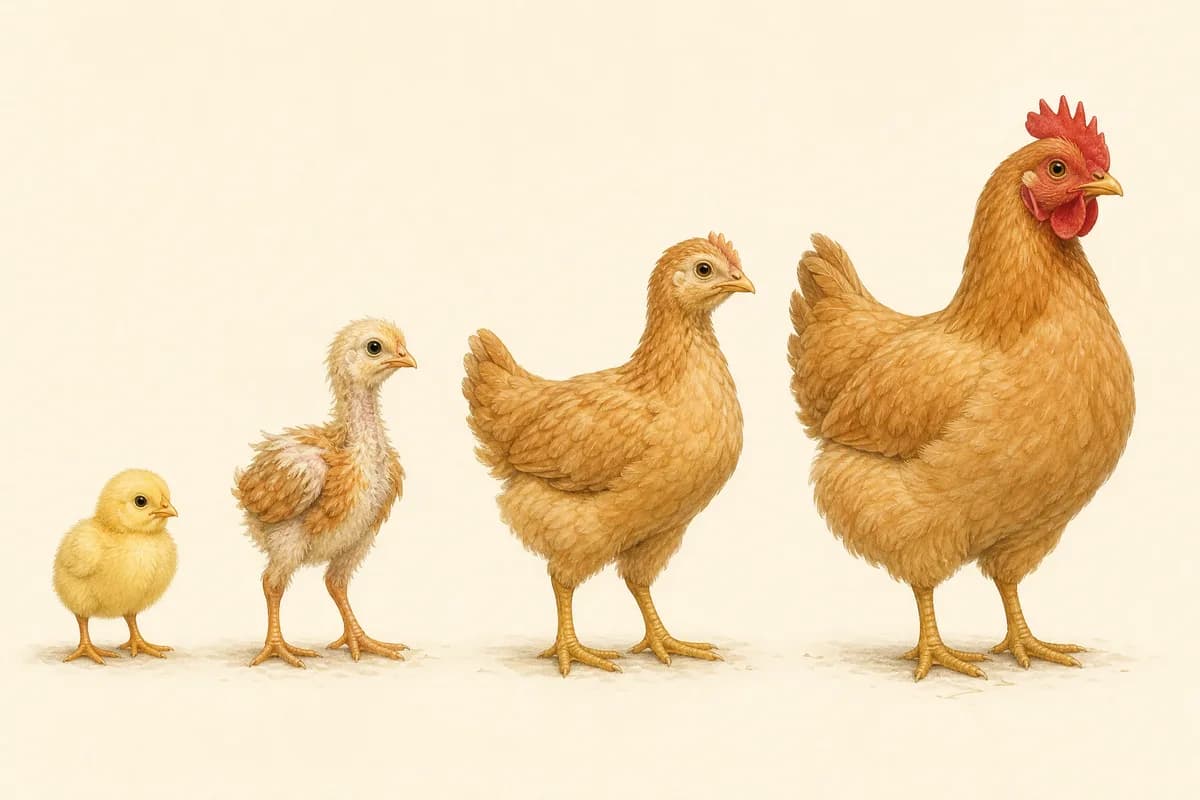
| Age | What's happening | What to do |
|---|---|---|
| Day 1 | Chicks arrive | Brooder at 90–95°F, water and starter feed ready |
| Weeks 1–5 | Rapid growth in the brooder | Lower the heat about 5°F a week |
| Weeks 4–8 | Feathering out | Heat off once well feathered; move outside in mild weather |
| Weeks 6–8 | Starter feed ends | Switch to grower or developer feed |
| Weeks 6–16 | Growing pullets | Roosts, room to move, natural daylight only |
| Week 16 | Pre-lay | Nest boxes in; still no layer feed |
| Weeks 18–22 | First eggs | Layer feed by the first egg; lights optional at 18 weeks |
| Week 35 | Peak laying | Keep feed, water and light steady |
How the calculator counts
Week 0 is the hatch day. If you don't know it, choose About how many weeks and the calculator works back from your pullets' age today, so the dates are only as close as your guess.
The first-egg window of 18 to 22 weeks comes from Mississippi State University Extension and University of Florida IFAS; Oregon State gives 18 to 20 weeks. Breed type shifts where your birds are likely to land in that window: Mississippi State notes that "lighter breeds tend to mature faster than heavier breeds," and Utah State says timing varies "considerably depending on breed and strain," up to about 7 months.
The daylight check uses your state to estimate day length when your pullets reach laying age. Texas A&M AgriLife Extension explains that "increasing day length stimulates maturing pullets to lay," and Penn State says production falls when days dip below 12 hours. If your window lands in short fall or winter days, expect eggs on the later side.
Weeks 0–5: the brooder
Heat
Chicks can't keep themselves warm at first. University of Kentucky Extension says brooding is "started at 90-95°F for the first week," measured at chick level, and "the temperature is reduced by 5°F weekly until about 70°F." Mississippi State gives the same pattern, starting at 92–95°F and ending at 65–70°F. Mississippi State's brooding sheet breaks it down:
| Chick age | Brooder temperature |
|---|---|
| Days 1–7 | 90–95°F |
| Days 8–14 | 85–90°F |
| Days 15–21 | 80–85°F |
| Days 22–28 | 75–80°F |
| Days 29–35 | 70–75°F |
The chicks will tell you if it's right:
- Too cold: they "huddle together trying to get as close to the heat source as possible" (Kentucky).
- Too hot: they "try to get as far away from the heat source as they can" (Kentucky), and may "pant, and are drowsy" (Mississippi State).
- Drafty: Mississippi State says chilled chicks "huddle together on the opposite side" from a draft.
Space, feed and water
- Space: Kentucky recommends "at least 0.5 square feet per chick up to four weeks of age" and "one square foot per chick" from four to eight weeks.
- Feeder space: University of Minnesota Extension suggests "1 linear inch of feeder space per chick," increasing "to 2 inches once the chicks are 2 weeks old."
- Water: Minnesota suggests a "one-gallon water fountain per 50 chicks during the first 2 weeks." Water matters most of all: Kentucky warns that "dehydration is the most common cause of death in young chicks" and suggests dipping each chick's beak in the water when it arrives.
Health from day one
Kentucky Extension says "it is strongly recommended that your day-old chicks be vaccinated for Marek's Disease. This is done at the hatchery," so ask when you order. Coccidiosis is the big risk for young birds: Mississippi State calls it "the most common disease found in young, unmedicated flocks." Minnesota recommends a feed with "a low-level coccidiostat drug" during brooding and growing. Kentucky also describes a coccidiosis vaccine some hatcheries offer for floor-raised chicks; ask your hatchery which one your chicks received.
Weeks 0–8: starter feed
Chicks start on a high-protein starter feed. Mississippi State's beginner guide lists starter at "20–24 percent protein," Ohio State's poultry team uses 20 percent for "approximately 6 weeks," and Minnesota feeds starter "for the first 6 to 8 weeks."
Weeks 4–8: feathering out
Heat stays on until the chicks have real feathers. Kentucky: "provide chicks with supplemental heat for the first 4-6 weeks," and "heat must be supplied until the chicks are well-feathered. This will vary between breeds and strains." Winter chicks may need heat longer.
Moving outside: University of Maryland Extension says "do not expose young birds to outside elements until they have grown in their permanent feathers." University of Arizona Extension puts it at "about 6-8 weeks, when chicks are fully feathered," as long as "nighttime temps are moderate (>50F or so)."
Weeks 6–16: growing pullets
Grower feed
After starter, pullets move to a grower or developer feed. Minnesota switches after 8 weeks; Mississippi State lists grower at "18–20 percent protein," and Texas A&M keeps pullets on a "16 percent protein pullet developer until the first egg is laid." Growing birds don't need the extra calcium in layer feed: poultry extension specialists note that "growing chickens require only 1.2% calcium," and too much can cause kidney damage.
Roosts and room
- Roosts: Minnesota says "you may use roosts for pullets over 6 weeks of age," using "rounded, 2-inch, non-metal materials," with "6 linear inches of roosting space for pullets." Penn State recommends six inches per standard-size bird as adults (four for bantams).
- Coop space: sources vary. Penn State's minimums are 1.5 square feet inside and 8 square feet of run per laying hen (1 and 4 for bantams). Virginia Tech recommends 3–4 square feet inside and 10 in the run, noting "you can never provide too much space."
Grit
UC Agriculture and Natural Resources notes that birds eating only pelleted feed don't need grit. If yours forage or get scratch, Minnesota says to make sure they "have chick- or pullet-sized grit available at the appropriate age," and Mississippi State notes birds with outside access "will select grit from their environment."
Natural light only
Don't light growing pullets to hurry them along. Utah State says to "limit light exposure to 10–12 hours per day until pullets reach sexual maturity (around 18 weeks)," because "longer light exposure can trigger premature egg laying, leading to small body size, poor-quality eggs." Texas A&M agrees: "do not expose pullets to artificial light until 18 weeks of age."
Week 16: getting ready to lay
- Nest boxes in. Poultry extension specialists say "it is important for pullets to have access to nesting boxes before they start to lay," and Utah State lists adding them at 16 to 20 weeks. Plan on about one box for every four hens (Penn State, Texas A&M).
- Still no layer feed. Texas A&M: "Do not feed a layer feed to pullets less than 16 weeks of age."
Weeks 18–22: first eggs
Watch for the signs in our guide to when chickens start laying: bigger, redder combs and wattles, and pullets poking their heads into the nest boxes.
Feed: switch to a layer feed by the first egg. Texas A&M switches "at the first egg" to a "16 to 18 percent protein laying ration containing 3.5 percent calcium"; Utah State and Penn State start layer feed from about 16 to 18 weeks.
Light (optional): if you use a lighting program, Texas A&M says "at about 18 weeks of age, pullets should be placed on a 14-hour day length." Increase light gradually and mind fire risks; see why chickens stop laying for safe lighting tips.
First eggs are often small or odd. Double yolks are "most frequently seen in young pullets whose reproductive systems are still developing" (Utah State), and Ohio State notes that "as the hen ages, the egg size will increase."
Mixing pullets with older hens
If your new pullets came from outside your flock, USDA APHIS says to "quarantine new birds from the rest of your flock for at least 30 days and watch carefully for signs of sickness."
To mix young birds with an existing flock, University of Arizona Extension suggests a barrier "that the chicks can't get out of, and the hens can't get in," so the groups can see each other, and to start mixing "once chicks are around the same size as the hens." Add "extra waterers, feeders, and roost space" so the newcomers aren't pushed away.
Weeks 18–35: up to peak
Oregon State says hens reach peak production at about 35 weeks. Once the first eggs arrive, log them in our free Egg Log and watch your new layers ramp up. If older hens are molting while your pullets start, see our chicken molting guide.
Sources
- University of Kentucky ASC-232: Raising Replacement Pullets for Small-scale Egg-production Enterprises
- Mississippi State University Extension P3624: Poultry Beginnings
- Mississippi State University Extension 1338: Brooding Chickens and Quail
- Mississippi State University Extension 268: The Home Flock
- University of Minnesota Extension: Raising Layer Chicks and Pullets
- Ohio State University Poultry Team: Raising Baby Chicks
- University of Maryland Extension: Raising Young Birds
- University of Arizona Extension: New Chicks and Old Flocks
- Texas A&M AgriLife Extension PSS-250: The Small Laying Flock
- Utah State University Extension: Managing Chickens From Chicks to Peak Egg Production
- Utah State University Extension: A Farmer's Guide to Egg Quality, Safety and Flock Health
- Penn State Extension: Small Scale Poultry Housing
- Virginia Cooperative Extension 2902-1092: Small-scale Poultry Housing
- Penn State Extension: Artificial Lighting for Winter Egg Production
- Oregon State University Extension, publication PNW 565
- UF/IFAS PS029: Factors Affecting Egg Production in Backyard Chicken Flocks
- Poultry Extension: Feeding Chickens for Egg Production
- Poultry Extension: Raising Chickens for Egg Production
- USDA APHIS Defend the Flock newsletter, Summer 2019
- Ohio State University: Chicken Breed Selection
- UC Agriculture and Natural Resources: Feeding Your Flock
Last updated October 26, 2026. Figures checked against the university extension sources linked above. See our editorial policy.