Winter Lights for Laying Hens: How to Add Light Safely
Updated October 26, 2026 · Fact-checked against university extension sources (how we check)
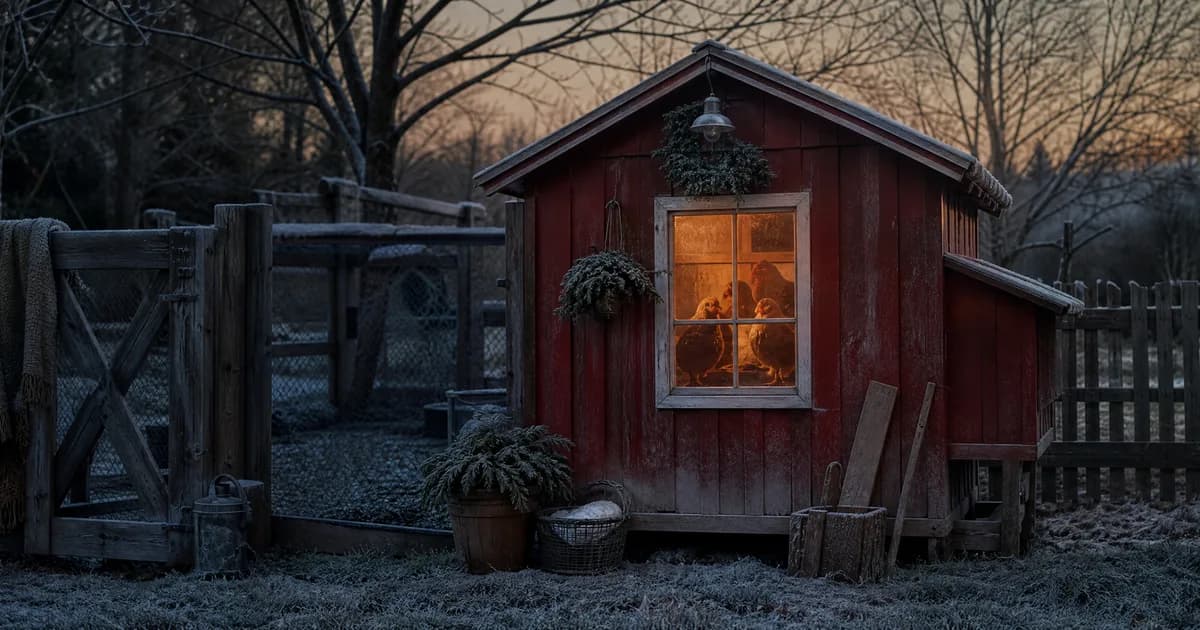
Short days are the main reason backyard hens slow down or stop laying in late fall. You can bring the eggs back with a light on a timer, or let your hens rest until spring. Both are fine choices. Here's what extension specialists say about each, and how to add light safely if you do.
Not sure whether short days are the problem? Our guide to why chickens stop laying walks through the other common causes, and the Egg Log will show you whether the drop was gradual (the season) or sudden (something else).
Why hens stop laying in winter
Laying is driven by day length. Oregon State University Extension says that for hens to keep laying, "day length must increase or remain constant at more than 12 hours per day," and that "a 14- to 16-hour day is typical" for laying hens. Penn State Extension sees production drop "in September and October when the photoperiod reaches and dips below 12 hours per day." University of New Hampshire Extension puts the slowdown a little earlier: "When the daylight drops below around 14 hours per day, chickens will slow their egg production."
Poultry Extension sums it up: "many flocks that are not provided with supplemental light go out of production during the fall and winter months."
Option 1: Let your hens rest
You don't have to light the coop. NC State Extension says to "go ahead and let your hens rest during the shorter daylight months of the year," and Penn State agrees that "it does not harm the birds to allow them to molt naturally. They will return to production again in the spring."
Resting has a real benefit: the molt. University of New Hampshire Extension notes that "molting is the only way they can maintain a healthy set of feathers," and warns that lights can "interfere with the birds' natural need and cycle of molting." Oregon State adds that "it is a good idea to allow hens to molt during their second winter," because "when molting during long day periods, the molt often is not complete." Our chicken molting guide covers how to help them through it.
Option 2: Add light for winter eggs
If you'd rather keep eggs coming, here's how extension sources say to do it.
How many hours
Aim for 14 to 16 hours of light a day, natural plus added. Penn State, Oregon State, Illinois and Utah State Extension all give 14 to 16 hours. Penn State's target for mature hens is 16 hours, and Utah State says laying hens need "at least 14 hours of light to maintain good egg production."
Don't go over 16. Penn State warns "too long a photoperiod causes stress in chickens," and adds: "Make sure hens still get a dark period."
Add it in the morning
Penn State recommends adding light "in the early morning" and letting "the natural sunset tell the birds when to come back to the coop to roost." That way the hens are already settled on their roosts when it gets dark. Poultry Extension notes you can add light in the morning, the evening or both, as long as the total reaches 14 to 16 hours.
To work out when the light should switch on, take the hours you want (say 15), subtract your hours of daylight, and count back that many hours from sunrise.
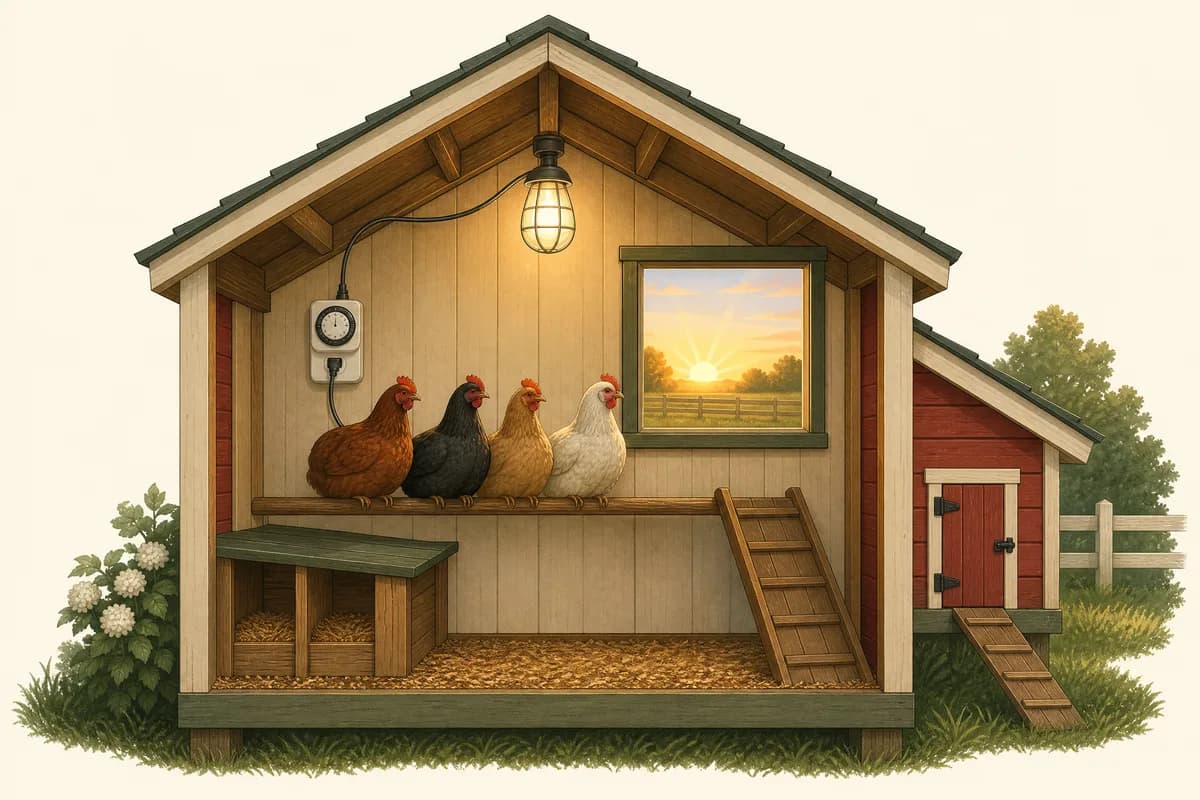
Use a timer, and never skip a day
Oregon State says "it is best to use an inexpensive timer to control the light schedule," and Penn State advises you to "develop a lighting program for the year to plan timer adjustments." Poultry Extension mentions you can also add a light sensor so the bulb stays off when there's enough daylight.
Consistency matters more than anything. Oregon State is blunt: "If a lighting program is started, it must be continued," and "even a 1-day lapse can have a negative impact on egg production." Penn State adds: "Never decrease the lighting period on birds in production, or they will stop laying."
Change it slowly
Penn State says to change the light "no more than 1 hour difference each week." If your hens have already stopped, build back up to 14 to 16 hours over a few weeks rather than all at once.
How bright, and what bulb?
You need less light than you'd think. Oregon State's test: light "just bright enough to read a newspaper." Penn State says hens need "a minimum of ½ foot-candle (5 lux)," and Poultry Extension gives the same half a foot-candle for laying birds.
Too much light causes its own problems. Penn State warns that "lights that are too bright can lead to stress and pecking problems."
Sources describe the bulb in slightly different ways:
| Source | Bulb guidance |
|---|---|
| Penn State | Bulbs "up to 30-40 watts"; one 25- to 40-watt bulb per 100 sq ft |
| Illinois Extension | A 60-watt incandescent or 800-lumen equivalent with a reflector for 200 sq ft |
| Texas A&M | One 60-watt bulb per 200 sq ft |
| University of New Hampshire | A 25-watt bulb, or LED |
For color, Penn State recommends "warm" bulbs "rated less than 3500K," and says "incandescent, LED, and other types are all fine." Poultry Extension notes that "orange-red light stimulates reproduction" and that fluorescent lamps "do not work well, and sometimes do not work at all, in very cold weather." UNH points out that LEDs "don't generate the heat of an incandescent" bulb. Keep bulbs clean: Poultry Extension says "dirty lamps give off reduced light intensity."
Fire safety first
A coop is full of dry bedding and dust, so treat every electrical item with care.
- No heat lamps for lighting. Penn State specifically says warm bulbs, "not heat lamps!" UNH says to "use a lamp that won't generate too much heat, as this can be a fire hazard."
- Out of reach. Penn State says to place lights "where birds cannot jump on them or peck at them."
- Listed equipment, no extension cords. The National Fire Protection Association says coop equipment "should be listed by a qualified testing laboratory," that receptacles should be planned "to avoid the need to use extension cords," and that "all receptacles should be provided with ground-fault circuit interrupter (GFCI) protection."
- Keep it clean. NFPA advises cleaning dust off electrical parts regularly and using "light fixtures with fully enclosed lamps."
Pullets: wait until 18 weeks
Don't add extra light to young birds. Texas A&M says "do not expose pullets to artificial light until 18 weeks of age," then moves them to a 14-hour day. Utah State says to limit light to 10 to 12 hours until about 18 weeks, because "longer light exposure can trigger premature egg laying, leading to small body size, poor-quality eggs, and health issues."
Our Laying Calculator works out when your pullets reach 18 weeks and checks the daylight in your state at laying age, so you know whether winter will slow their start.
Sources
- Penn State Extension: Artificial Lighting for Winter Egg Production
- Penn State Extension: Management Requirements for Laying Flocks
- Oregon State University Extension PNW 565: Why Did My Chickens Stop Laying?
- Texas A&M AgriLife Extension PSS-250: The Small Laying Flock
- Utah State University Extension: Managing Chickens From Chicks to Peak Egg Production
- Utah State University Extension: Basics for Raising Backyard Chickens
- University of New Hampshire Extension: How Should I Take Care of Backyard Chickens in the Winter?
- University of New Hampshire Extension: Producing Your Own Eggs
- University of Illinois Extension: How to Care for Backyard Chickens in Winter
- Poultry Extension: Lighting for Small and Backyard Poultry Flocks
- Poultry Extension: Raising Chickens for Egg Production
- NC State Extension: Keeping Garden Chickens in North Carolina
- National Fire Protection Association: DIY Chicken Coop Fire and Electrical Safety