Barred Plymouth Rock
The black-and-white striped backyard favorite: calm, cold-hardy and a top pick for beginners.
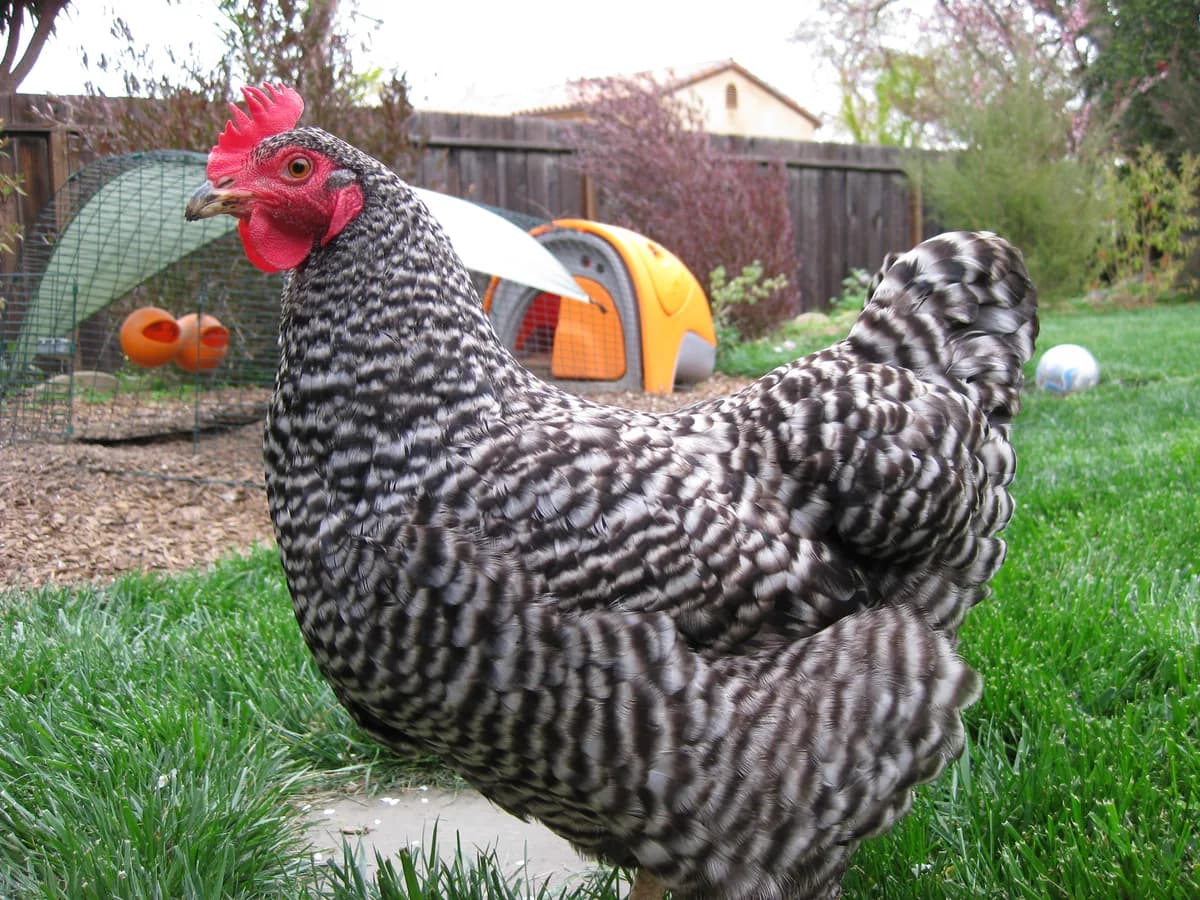
Photo: Thomas Kriese, CC BY 2.0, via Wikimedia Commons, cropped

Barred Plymouth Rock at a glance
Medium, dual-purpose
- Status
- APA breed, American class. Barred variety admitted 1874, in the first American Standard.[1][2]
- Origin
- Developed in America in the mid-1800s; first exhibited in 1869 at Worcester, Massachusetts.[3][2]
- Eggs per year
- 200–280[5]
- Egg size
- Large[6]
- Weight
- Standard 9.5 lb rooster, 7.5 lb hen. Mississippi State gives a much lower backyard range of 4 to 7 lb.[4][3]
- Bantam
- Yes (Barred bantam admitted 1940).[1]
- Good for beginners
- Ohio State lists Plymouth Rocks among good choices for novice keepers.[6]
- Cold
- Does not mind the cold.[6]
- Varieties
- Barred (1874), White (1888), Buff (1894), Silver Penciled (1907), Partridge (1909), Columbian (1910), Blue (1920)[1]
- Conservation
- Not on the Livestock Conservancy's priority list.[7]
- How to spot one
- Black-and-white barred feathers, single comb, red earlobes, yellow skin and yellow, clean shanks.[4]
Facts no source backs up are left out. Updated October 26, 2026 (how we check).
The Barred Plymouth Rock, usually just called the Barred Rock, is the black-and-white striped hen that's been scratching around American farmyards since the 1800s. It's calm, productive and hardy, and it shows up on almost every "best breeds for beginners" list for good reason.
A true American original
Plymouth Rocks were developed in America in the mid-1800s, says Mississippi State Extension. Illinois Extension notes the barred birds were first exhibited in 1869 at Worcester, Massachusetts, and the Barred variety was admitted to the very first American Standard of Excellence in 1874.
The barred pattern was only the start. Illinois Extension lists the later varieties: White (1888), Buff (1894), Silver Penciled (1907), Partridge (1909), Columbian (1910) and Blue (1920). "Barred Rock" means the original striped one.
Eggs
University of New Hampshire Extension puts the Barred Rock at 200 to 280 eggs a year. The eggs are brown (Mississippi State) and large (Ohio State). That's a steady, generous supply for a family, from a bird that's also big enough for meat, which is why it's called dual-purpose.
Raising pullets? Plug their hatch date into our Laying Calculator to see when to expect the first egg, then keep count in the Egg Log.
Temperament
Barred Rocks are docile, according to Mississippi State, and Ohio State includes the Plymouth Rock among breeds with a reputation for docility. That's a big reason Ohio State lists them as a good choice for novice keepers.
Broodiness and mothering
Ohio State calls Plymouth Rocks "broody chickens that will make good mothers," and Mississippi State notes their good mothering instincts. If you'd like to hatch chicks under a hen someday, a Barred Rock is a good candidate.
Size
The standard weight is 9.5 lb for a rooster and 7.5 lb for a hen (UF/IFAS). Mississippi State gives a much lighter range of 4 to 7 lb for adult birds, which reflects how much backyard and hatchery birds can differ from show stock. A bantam version exists too (Illinois Extension).
Weather
Ohio State says Plymouth Rocks "do not mind the cold." None of our sources rate their heat tolerance, so in hot climates give them the shade, ventilation and fresh water every flock needs.
How to recognize a Barred Rock
The feathers are crossed with even black-and-white bars. UF/IFAS lists a single comb, red earlobes, yellow skin and yellow, unfeathered shanks. The Livestock Conservancy doesn't list the Plymouth Rock on its priority list, so these birds are easy to find from hatcheries and breeders.
Is a Barred Rock right for you?
If you want a calm, cold-tolerant bird that lays plenty of brown eggs and might raise chicks for you, the Barred Rock is hard to beat. Compare it with the Rhode Island Red, which lays a few more eggs, or the Speckled Sussex, another friendly forager.
See every breed's egg color side by side on our free Egg Color Chart printable.