Brahma
The gentle giant: up to 12 lb, feathered feet, and built for cold winters rather than hot summers.
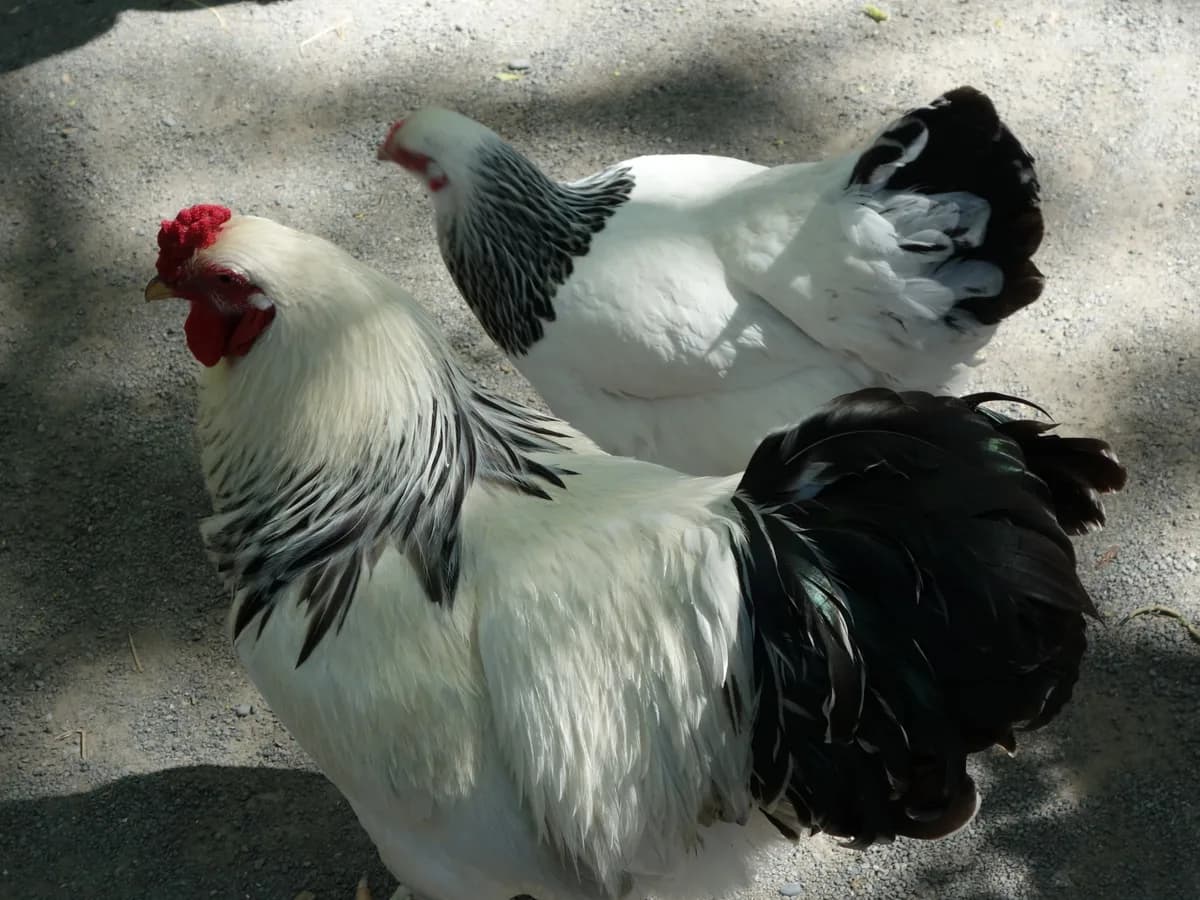

Brahma at a glance
Large and heavy
- Origin
- Traces back to large fowl from China, developed in the US between 1850 and 1890. Illinois Extension suggests a Malay–Cochin cross from India.[3][4][5][6]
- Egg size
- Large[7]
- Bantam
- Yes.[2]
- Heat
- Not ideal for warmer climates.[4]
- Conservation
- Not on the Livestock Conservancy's priority list.[8]
Facts no source backs up are left out. Updated October 26, 2026 (how we check).
Brahmas are the gentle giants of the backyard. A big Light Brahma rooster can weigh 12 pounds, with feathers down to his toes, yet the breed is known for a calm, gentle nature. If you have cold winters, a Brahma may be the hen for you.
From Asia to America
UW–Madison Extension says the Brahma's ancestry "traces back to China," and Oklahoma State says much of its development took place in the US between 1850 and 1890. Mississippi State agrees it was developed in America from large fowl imported from China in the mid-1800s. Illinois Extension offers another theory: a cross of the Malay and Cochin in India. Oklahoma State notes the name comes from the Brahmaputra river.
The Light and Dark varieties were admitted to the American Poultry Association's Standard in 1874, and Buff in 1924, in the Asiatic class.
Size: truly big birds
The standard weight for a Light Brahma is 12 lb for a rooster and 9.5 lb for a hen; Dark and Buff Brahmas are 11 and 8.5 lb (UW–Madison, Oklahoma State). Mississippi State gives an adult range of 8 to 12 lb. Bantam Brahmas exist for smaller spaces.
Oklahoma State notes Brahmas grow slowly and take a long time to reach maturity. Our Laying Calculator uses the heavy-breed setting, which expects first eggs toward the later end of the usual window.
Eggs
Brahmas lay light to dark brown eggs (Mississippi State), rated large by Ohio State. UW–Madison calls them "fair egg layers," and Mississippi State says they're "good egg layers for their size." None of our sources give a yearly count, so let the Egg Log tell you what yours lay.
Temperament
Their "gentle nature" is what UW–Madison and Oklahoma State highlight, and Ohio State calls Buff Brahmas "a gentle breed." Oklahoma State says their size, gentle nature and color patterns make them favorites with showmen and fanciers.
Broodiness
"Brahmas do go broody and are fairly good mothers," says UW–Madison, and Ohio State calls them a broody breed.
Built for cold, not heat
UW–Madison explains that their pea combs and "well feathered shanks and toes enable them to stand cold temperatures very well." Mississippi State calls Brahmas "extremely hardy" and says they "stand the cold very well but are not ideal for warmer climates." In hot summers they need deep shade and good airflow.
How to recognize a Brahma
The low pea comb and feathered shanks and toes are the giveaways. Illinois Extension lists the Brahma among pea-combed breeds; Oklahoma State describes red wattles and earlobes and yellow skin. Mississippi State lists three varieties: Light, Dark and Buff.
Is a Brahma right for you?
Choose Brahmas if you have cold winters, room for big birds and want a calm, gentle flock. In hot climates, look at a heat-tolerant breed like the White Leghorn. For another fluffy, feather-footed gentle bird, compare the Cochin.
See how Brahma eggs compare with every breed here on our free Egg Color Chart printable.