Speckled Sussex
Curious, people-loving and handsomely speckled: a calm forager and a great beginner bird.
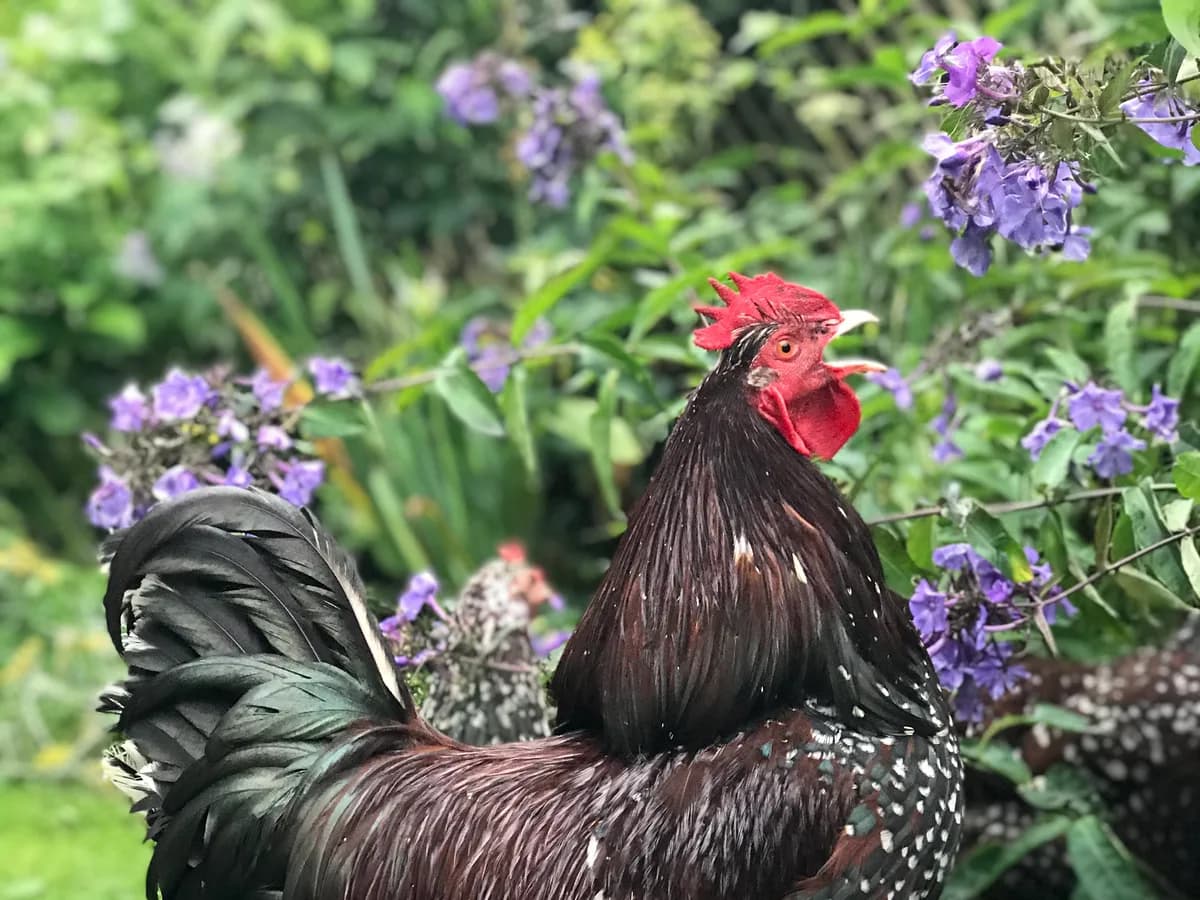
Photo: Chefsbird, CC BY-SA 4.0, via Wikimedia Commons, cropped

Speckled Sussex at a glance
Medium, dual-purpose
- Eggs per year
- 200–250[3]
- Weight
- Standard 9 lb rooster, 7 lb hen (the Livestock Conservancy gives 6–7.5 lb as market weight).[3][4][5]
- Bantam
- Yes.[2]
- Good for beginners
- The Livestock Conservancy calls the Sussex a suitable breed for beginners.[3]
- Cold
- Does well in winter.[3]
- Heat
- Not fond of the heat.[3]
Facts no source backs up are left out. Updated October 26, 2026 (how we check).
The Speckled Sussex is the curious one in the flock: a calm hen that, in the Livestock Conservancy's words, likes people. Add striking multi-colored speckled plumage and steady laying, and it's easy to see why keepers love it.
An old English breed
The Sussex originated in the county of Sussex, England, where it was prized as a table bird more than 100 years ago (UW–Madison Extension). Oklahoma State says it reached the United States around 1912, and Illinois Extension lists the Speckled variety's admission to the American Poultry Association's Standard in 1914. It's in the English class.
The APA recognizes three Sussex colors: Speckled, Red and Light. Other colors exist; the Livestock Conservancy notes the Brown is recognized in England.
The Livestock Conservancy lists the Sussex as Recovering, so keeping them helps a heritage breed.
Eggs
The Livestock Conservancy puts the Sussex at 200 to 250 large tan to brown eggs a year. That's a steady supply from a bird that's also a good size for the table; Oklahoma State calls it "one of the best of the dual purpose chickens."
Time your pullets' first egg with the Laying Calculator and keep count in the Egg Log.
Temperament: calm, curious and people-loving
This is the Sussex's best feature. The Livestock Conservancy describes them as "calm and curious" and says "they are curious and like people." UW–Madison calls them "alert, attractive, and good foragers," and Oklahoma State says they are considered "stout and easy to handle."
The Livestock Conservancy calls the Sussex "a suitable breed for beginners."
Broody and motherly
Sussex hens go broody and make good mothers, say both the Livestock Conservancy and UW–Madison. If you'd like to raise chicks the old-fashioned way, a Speckled Sussex hen is a great choice.
Climate
The Livestock Conservancy says the Sussex "does well in the winter but is not fond of the heat." In a hot climate, give them plenty of shade and fresh water.
Size
The standard weight is 9 lb for a rooster and 7 lb for a hen (Livestock Conservancy, UW–Madison, Oklahoma State). The Livestock Conservancy gives a market weight of 6 to 7.5 lb. A bantam version exists.
How to recognize a Speckled Sussex
Beyond the speckled plumage, the Livestock Conservancy describes a rich red, five-pointed single comb, red earlobes, white skin, and whitish shanks with four toes. Oklahoma State adds close-fitting feathers and a rectangular body. The legs are clean, without feathers.
Is a Speckled Sussex right for you?
Pick Speckled Sussex if you want friendly, chatty hens that forage well, lay steadily and might raise your next generation of chicks. For another calm, cold-tolerant beginner bird, see the Barred Plymouth Rock; for an even fluffier sweetheart, try the Buff Orpington.
Our free Egg Color Chart printable shows where the Sussex's tan eggs fit among every breed here.