Delaware
A calm white heritage hen with a black-barred neck and tail, laying large to jumbo brown eggs.
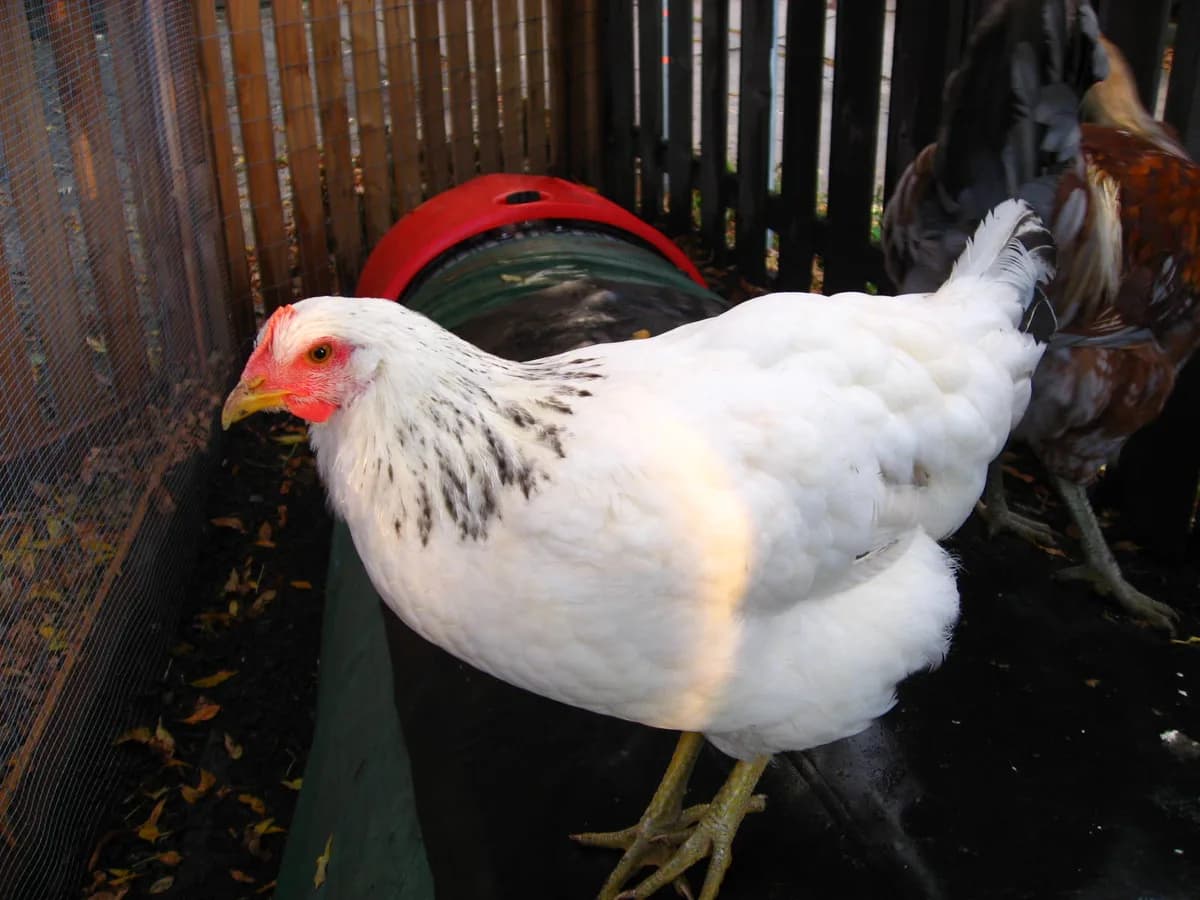
Photo: Linda from Chicago, USA, CC BY 2.0, via Wikimedia Commons, cropped

Delaware at a glance
Medium, dual-purpose
- Origin
- First developed in 1940 in Delaware, from off-colored chicks of Barred Rock × New Hampshire crosses; originally called the Indian River.[3][4]
- Weight
- Sources differ: 8.5 lb rooster, 6.5 lb hen (Oklahoma State) or 7.5 and 5.5 lb (Livestock Conservancy).[5][4][6]
- Broodiness
- Not generally broody (Livestock Conservancy), though Oklahoma State says hens go broody on occasion.[4][5]
- Conservation
- Listed as Recovering by the Livestock Conservancy.[4]
Facts no source backs up are left out. Updated October 26, 2026 (how we check).
The Delaware is a striking white heritage hen with black barring on her neck and tail. She's calm, friendly and lays big brown eggs, and she's a breed the Livestock Conservancy is still working to bring back.
A Delaware original
Illinois Extension says the Delaware was first developed in 1940 "from off-colored sports which occurred in the cross between Barred Plymouth Rock males and New Hampshire females." The Livestock Conservancy says it was originally called the Indian River chicken, after George Ellis of Indian River, Delaware. The American Poultry Association admitted it in 1952, in the American class, with one variety.
Eggs
All our sources agree on brown shells, with the Livestock Conservancy calling them light brown. Ohio State rates them large, and the Livestock Conservancy says large to jumbo.
How many is where sources split: the Livestock Conservancy says about 4 eggs a week, up to 200 a year, while Oklahoma State says 100 to 150. Your own Egg Log will settle it for your flock. To time first eggs, use the Laying Calculator.
Temperament
Mississippi State says Delawares "have a calm and friendly disposition," and Oklahoma State calls them gentle and not known to be aggressive. The Livestock Conservancy adds two honest notes: they aren't considered a cuddly breed, and they can be loud.
Broodiness
The Livestock Conservancy says the Delaware "is not generally a broody breed," while Oklahoma State says hens go broody on occasion. Expect more eggs than chicks.
Size
Sources differ here too. Oklahoma State gives 8.5 lb for a rooster and 6.5 lb for a hen; the Livestock Conservancy lists 7.5 and 5.5 lb, and Mississippi State says adults weigh 5.5 to 7.5 lb. Bantams exist (Oklahoma State gives 34 oz and 30 oz).
Conservation
The Livestock Conservancy lists the Delaware as Recovering. Keeping a few helps a breed that was once rare.
How to recognize a Delaware
Oklahoma State describes "a white bird with black barred plumage near the neck area," with black-barred tail feathers too, a single red comb, red wattles and earlobes, yellow shanks and white skin. The Livestock Conservancy adds that the single comb has five points. Ohio State sums it up: mostly white with a barred tail and hackle.
Is a Delaware right for you?
Choose Delawares for a calm, good-looking heritage flock with big brown eggs. They come from a Barred Rock and New Hampshire cross, so if you like them, read about the Barred Plymouth Rock and the New Hampshire too.
Compare egg colors on our free Egg Color Chart printable.