Salmon Faverolles
A bearded, muffed French hen with feathered feet and five toes, laying tinted eggs through winter.
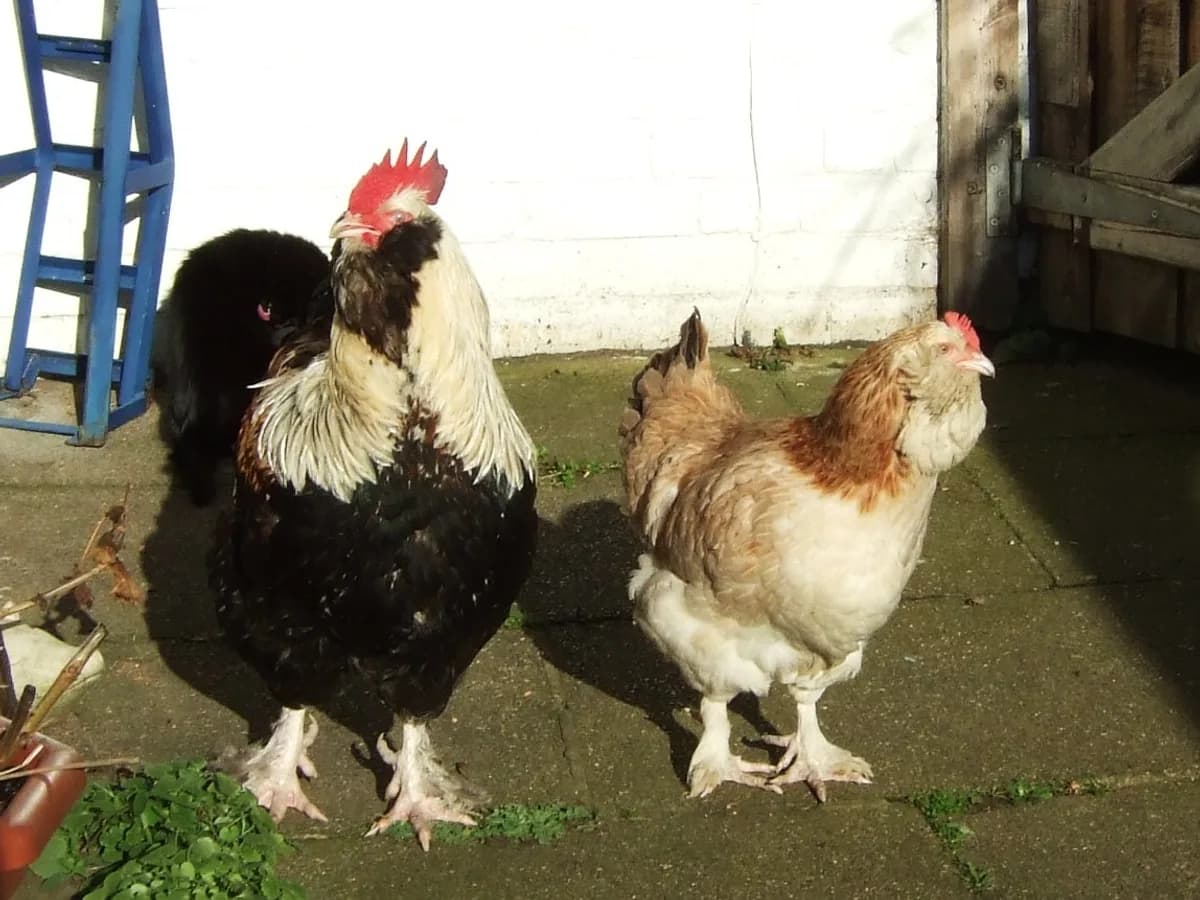
Photo: stephen jones from uk, CC BY 2.0, via Wikimedia Commons, cropped

Salmon Faverolles at a glance
Medium, dual-purpose
- Origin
- Developed in Faverolles, France, from Houdans, Dorkings and Asiatic fowl; reached the US in the early 1900s.[4][2]
- Eggs per year
- Up to 150–200[2]
- Egg size
- Medium[6]
- Cold
- Abundant feathers protect them in winter, and they keep laying when others stop.[2]
Facts no source backs up are left out. Updated October 26, 2026 (how we check).
With a fluffy beard, puffy muffs, feathered feet and five toes on each foot, the Salmon Faverolles looks like no other chicken. It's also a practical bird that keeps laying through the winter.
From the village of Faverolles, France
UW–Madison Extension says the Faverolles was developed in Faverolles, France, as a composite of Houdans, Dorkings and Asiatic fowl. Oklahoma State says it originated around the 1800s and came to the United States in the early 1900s.
The American Poultry Association recognized the Salmon variety in 1914 and the White in 1981 (Oklahoma State). Faverolles are in the Continental class, with bantams in the Feather Leg class.
Eggs
UW–Madison lists the eggshell as light brown, and Illinois Extension says Faverolles lay tinted rather than white eggs. Ohio State rates them medium. Oklahoma State says they lay up to 150 to 200 eggs a year and "continue to lay eggs in the winter where other birds will have stopped."
Log your winter eggs in the Egg Log, and find out when pullets will start with the Laying Calculator.
Winter-ready feathers
Oklahoma State says the Faverolles has "an abundance of feathers, giving the bird winter protection." Combined with winter laying, that makes it a good pick for cold-climate keepers.
Temperament
We couldn't find an extension source that rates the Faverolles' temperament on its own. Purdue Extension describes Continental breeds in general as having "active flighty dispositions," naming the bearded Faverolles in that group, but that's a broad class description, so we don't treat it as a breed rating.
Size
The standard weight is 8 lb for a rooster and 6.5 lb for a hen (UW–Madison, Oklahoma State). Bantam Faverolles weigh about 30 oz for a rooster and 26 oz for a hen (Oklahoma State).
How to recognize a Salmon Faverolles
Oklahoma State lists the giveaways: a beard and muffs on both sexes, a single comb and red earlobes, wattles that are barely visible or missing, light feathering down the legs and feet, white skin and shanks, and five toes. The salmon male is more brilliantly colored than the female, with darker hackles and tail.
Is a Salmon Faverolles right for you?
Choose Faverolles for a one-of-a-kind look and winter eggs. For another feather-footed bird with a famous temperament, see the Cochin; for another crested oddity, meet the Polish.
Compare egg colors on our free Egg Color Chart printable.